Contributing
This is the main information hub for drive-by contributors and regular developers alike. Everyone is encouraged to partake in documenting our project in here. Feeling insecure about an edit? Ask for affirmation in our Matrix channel :)
- Running Lix main
- Information organisation
- Intro to Gerrit
- Getting Started with Gerrit
- Review Flow
- Why Gerrit?
- Gerrit with Jujutsu
- Tips and Tricks
- Advanced Features
- Troubleshooting
- Working in the Lix codebase
- Codebase overview
- Freezes and recommended contributions
- Bug tracker organisation
- Gerrit
- Improving build times
- Commit porting (cherry-picking) guide
- Misc tips
- Building Locally
- RISC-V support
- Branches
- Working Groups
- Dealing with CI
- Style Guide
- Contributor permissions and Code Owners
Running Lix main
Thank you for choosing to help us dogfood in our daily development!
If you run into any issues, you can reach out for quick support in #running-main:lix.systems on Matrix.
There is a lot of work-in-progress documentation and a lot of it is work in progress or awaiting move to the wiki. Our apologies for this state, let us know if there is something you need.
If you run into any friction, please let us know. We would like to hear all your complaints.
Getting yourself set up with an account (if desired)
Sign in with GitHub on https://identity.lix.systems.
Note that your email will be visible on Gerrit if you use it, so change it on https://identity.lix.systems if necessary.
A brief tour of the Lix systems
See Information Organisation for where information is.
The Lix sources are developed on Gerrit and released on a Forgejo repo.
Contributor documentation for the project is maintained on this wiki. FIXME(jade): a lot of it is awaiting migration onto the wiki from the private pad system, see tracking issue.
On NixOS/nix-darwin
Use the overlay: https://git.lix.systems/lix-project/nixos-module
Please file bugs if this explodes the build of tooling you use, we can fix it in the overlay.
Flakes
Add Lix to your system configuration like so:
{
  inputs = {
    lix = {
      url = "https://git.lix.systems/lix-project/lix/archive/main.tar.gz";
      flake = false;
    };

    lix-module = {
      url = "https://git.lix.systems/lix-project/nixos-module/archive/main.tar.gz";
      inputs.nixpkgs.follows = "nixpkgs";
      inputs.lix.follows = "lix";
    };
  };

  outputs = {nixpkgs, lix-module, lix, ...}: {
    # or equivalent for darwin
    nixosConfigurations.your-box = nixpkgs.lib.nixosSystem {
      system = "x86_64-linux";
      modules = [
        ./machines/your-box
        lix-module.nixosModules.default
      ];
    };
  };
}
You can then update it with nix flake update lix; nix flake update lix-module.
Not flakes
Also supported.
Add inputs for git+https://git.lix.systems/lix-project/lix and git+https://git.lix.systems/lix-project/nixos-module to your preferred pinning tool.
Use in a NixOS module: e.g. imports = [ (import "${your-pinning-thingy.lix-nixos-module}/module.nix" { lix = your-pinning-thingy.lix; }) ];
Niv
Add the sources for the module and Lix itself, using ssh:// after registering your keys with git.lix.systems:
$ niv add git -n lix-nixos-module --repo 'https://git.lix.systems/lix-project/nixos-module'
$ niv add git -n lix-lix --repo 'https://git.lix.systems/lix-project/lix'
Then, import the Lix NixOS module:
imports = [
  (lib.importApply "${sources.lix-nixos-module}/module.nix" rec {
    lix = sources.lix-lix;
    versionSuffix =
      "pre${builtins.substring 0 8 lix.lastModifiedDate}-${lix.shortRev}";
  })
];
On other Linux or on macOS
Currently we are still working on the installer (see tracking project). It is possible to convert an existing Nix install to Lix.
flakey-profile
This is experimental. Some people have successfully used it on macOS. We have tested it on an Arch Linux system installed a long time ago with the shell-based installer, and it works fine. This method works by replacing your system profile with one that is built by simple Nix code with flakey-profile.
You can rollback if it blows up by /nix/var/nix/profiles/default-{SECOND-HIGHEST-NUMBER}/bin/nix-env --rollback --profile /nix/var/nix/profiles/default.
Clone https://git.lix.systems/lix-project/nixos-module.git, then, inside it, run sudo nix run --extra-experimental-features 'nix-command flakes' .#system-profile.switch.
Finally, run sudo systemctl daemon-reload && sudo systemctl restart nix-daemon, or, for macOS:
sudo launchctl stop system/org.nixos.nix-daemon
sudo launchctl enable system/org.nixos.nix-daemon
sudo launchctl kickstart -k system/org.nixos.nix-daemon
Restoring a broken install after a macOS update
After updating macOS, you may get error messages like these:
~/.nix-profile: no such file or directory
/nix/var/nix/profile/default: no such file or directory
error: cannot connect to socket at '/nix/var/nix/daemon-socket/socket': Connection refused
You can fix this by opening "Disk Utility" and manually mounting the Nix Volume again.
Then, run these commands to re-install the lix daemon:
sudo launchctl load /nix/var/nix/profiles/default/Library/LaunchDaemons/org.nixos.nix-daemon.plist
sudo launchctl kickstart -k system/org.nixos.nix-daemon
Manually, with nix profile
We::Qyriad have used these steps on macOS has it has seemed to work, but we would recommend flakey-profile over it.
$ sudo -H --preserve-env=SSH_AUTH_SOCK nix --experimental-features 'nix-command flakes' profile install --profile /nix/var/nix/profiles/default git+ssh://git@git.lix.systems/lix-project/lix --priority 3
--preserve-env=SSH_AUTH_SOCKassumes that your SSH agent is important to access the Lix repo--priority 3makes it symlink Lix over your existing Nix install
If you then run sudo nix --experimental-features 'nix-command flakes' profile list --profile /nix/var/nix/profiles/default, you should get output similar to this:
Index:              0
Store paths:        /nix/store/8ma7xas2nb0i3lq8mm7fpgalv94s8pzh-nss-cacert-3.92

Index:              1
Store paths:        /nix/store/53r8ay20mygy2sifn7j2p8wjqlx2kxik-nix-2.19.2

Index:              2
Flake attribute:    packages.aarch64-darwin.default
Original flake URL: git+ssh://git@git.lix.systems/lix-project/lix
Locked flake URL:   git+ssh://git@git.lix.systems/lix-project/lix?ref=refs/heads/main&rev=98b497a1a43a4ff39263ed5259f12c5d00b4d8c0
Store paths:        /nix/store/8040hxr4rr8bpb5yp4b48709x3qs4bwb-nix-2.90.0
You may then use sudo nix --experimental-features 'nix-command flakes' profile remove --profile /nix/var/nix/profiles/default 1 to remove your original installation of Nix. This is (probably) optional.
Verification
You should now get something like the following:
~ » nix --version
nix (Nix) 2.90.0-lixpre20240324-f86b965
Binary Cache
Note: the cache is operated on a best-effort basis and thus might be unavailable for short time-spans.
The AFNix Hydra builds Lix main and warms up a cache. The cache can be configured via
{
  nix.settings = {
    substituters = [ "https://afnix-hydra.s3-bulk-web.afnix.fr/" ];
    trusted-public-keys = [ "afnix:oqt801y+IwJ09XRtNDQYCKb7zuCw9DQXQk8fDWPkwxM=" ];
  };
}
Information organisation
Lix has a lot of information as a project, and we want to make it accessible in a way that it can be found later if necessary.
There are various tools for keeping information in the project, and they have different purposes
Chat
Chat is good for:
- Information that will be meaningless in hours
- Ephemeral discussions, in general
The chat is expected to move way too fast to follow. As such:
- Don't write things in chat that you expect to be found later
- If discussions of design happen, write them down, at least by copy pasting into a pad and adding the pad to the index
- If tips and tricks are discussed, please write them down
- Please do reviews on Gerrit so they are archived, rather than in chat
- Write things down in the log if they are expected to be found
Wiki (https://wiki.lix.systems)
The wiki is good for:
- Development process information, like you would find on https://rustc-dev-guide.rust-lang.org/ for the Rust compiler, for instance.
- Design documents
The wiki is not good for:
- User facing documentation
- Documentation that deserves to be reviewed
- Actively writing a document in real time with others
Markdown files in the Lix repo
Markdown files in the Lix repo are good for:
- Maintaining things that are tied directly to the code
- Documentation that needs to be reviewed
- User facing documentation
Markdown files in the Lix repo are bad for:
- Quickly iterating on things
- Design documents
Forgejo issues (https://git.lix.systems)
Our primary issue tracker is Forgejo issues.
We are currently attempting to use the Forgejo project boards feature to communicate what people are working on; it may be replaced with better Kanban software in the future. When making project boards on Forgejo, make them on the lix-project organisation unless they are strictly contained within one project.
The issue tracker is good for:
- Actionable work
- Bugs
The issue tracker is not good for:
- Dreams or otherwise not actionable information that is a long term goal
- Private information
- Information that needs to be found later, design documentation
Where to put an issue
- lix-project/lix, if it is contained within Lix (but is not more appropriate to put in the installer e.g.)
- If it is an upstream bug, tag its equivalent
lix-importon https://git.lix.systems/nixos/nix, and get someone with the bot token to run the issue import script inmaintainers/issue_import.py. (FIXME: someone ought to put that on a cron job) - Please never file issues on our Nix mirror.
- If it is an upstream bug, tag its equivalent
- lix-project/installer, if it is the installer
- lix-project/web-services, if it is infrastructure related
- lix-project/meta, if it does not fit anywhere obvious and you just need it to put it on a board
- lix-project/nixos-module, if it is a packaging bug in that specifically
Gerrit (https://gerrit.lix.systems)
Gerrit is good for:
- Reviewing code
- Maintaining a record of code reviews
Gerrit is not good for:
- Persisting information in a discoverable way to anyone in the future
- Documentation
Pad (https://pad.lix.systems [private])
We anticipate that the pad service will be semi-permanently private by default, since it doesn't support ACLs.
The pad is good for:
- Sketching out drafts of documents that aren't ready yet
- Planning private things
- Generally getting people on the same page about things in active design, making what might be meeting notes, or similar.
The pad is not good for:
- Information that should be available to users (unless it is planned to move)
- Information that is not actively changing
It is very important that pads remain temporary in nature, and are quickly moved to their final destination, e.g. the Wiki.
N.B. For users who aren't in the Lix core team, the service returns 500 when you attempt to login. This is a known issue that can't be fixed.
Intro to Gerrit
Everything about Gerrit: how to get started, advanced tips and tricks, and more!
Getting Started with Gerrit
Thanks for showing interest in contributing to Lix! Gerrit can seem daunting at first, but it is our hope that you'll learn to navigate it and use it confidently after finishing this tutorial.
Perhaps the first question you have is: "Why Gerrit"? Well, glad you asked! In fact, we have an entire page describing that. But in short: it's just very nice for working with code. Instead of "PR from a branch" model that Github uses, Gerrit assigns a Change-Id to a commit, which is preserved even when the commit itself changes. This is perhaps familiar to Jujutsu VCS users.
This model allows us to largely ignore branches, which have long been known to introduce many operational complexities. Instead, we can focus on getting the work done, with our tooling supporting us in this goal!
Setting Up
Here are a few things you will need. Let's go over them one by one.
- Go to our Gerrit instance and sign in. It will prompt you to sign in with Github SSO. If you don't want to use your Github account, that's fine; just hit us up on Matrix and we'll create you an account!
- Get your SSH key ready! If you don't have one, run
ssh-keygen -t ed25519to generate the SSH keypair with ed25519 cypher. It is the most secure SSH cypher currently available, and quite ergonomic to use! Passphrase isn't necessary for Gerrit, but if you want to use it, we recommend to also set up ssh-agent. - Go to your user settings in Gerrit, scroll down to "SSH keys", and add your public SSH key (from
~/.ssh/id_ed25519.pub).
Configuring Git Repo
Now, we need to make some setup for the Git repo. If you haven't yet cloned Lix repo, use this fancy one-liner to do it (just remember to change USERNAME to your actual username!):
git clone "ssh://USERNAME@gerrit.lix.systems:2022/lix" && (cd "lix" && mkdir -p `git rev-parse --git-dir`/hooks/ && curl -Lo `git rev-parse --git-dir`/hooks/commit-msg https://gerrit.lix.systems/tools/hooks/commit-msg && chmod +x `git rev-parse --git-dir`/hooks/commit-msg)
If you want to get a deeper understanding, or you already cloned the repo from Forgejo - read on!
This is a little awkward, but yes - we store a Git repo in both Forgejo and Gerrit. This is a technical limitation of our infra. The "actual" repo lives in Gerrit - and it is automatically mirrored to Forgejo. This means that we want to push changes directly to Gerrit.
- If you cloned the repository from Forgejo, rewrite the origin to point to Gerrit instead:
git remote set-url origin ssh://USERNAME@gerrit.lix.systems:2022/lix - Gerrit wants a
Change-Idfooter in your commit message to work (and track changes to your commit). Adding it by hand is very inconvenient; thankfully, there's a Git hook that adds this footer if it doesn't already exist, even on amends of existing commits. It is added automatically if you are innix developshell. Otherwise, you can add it manually:
 mkdir -p .git/hooks
 curl -Lo .git/hooks/commit-msg https://gerrit.lix.systems/tools/hooks/commit-msg
 chmod +x .git/hooks/commit-msg
- Now you can just
git commityour change. Before that, create a branch, but your commit is the unit of review here! - Gerrit also expects you to push in an unusual way, too:
git push origin HEAD:refs/for/main. Just run this command to automate it:git config remote.origin.push HEAD:refs/for/main. Now you'll be able togit pushlike normal! - Now, you can just
git push, and you'll see a link to your CL (Change List)! Now pat yourself on the back and wait for review :)
What Next?
Now, you should be getting a review in a few days - especially if your CL is quite small. Generally, Lix team goes through the open CLs quite often, and helps the new ones get to completion. Sometimes, people might be busy or just miss your CL - so don't take it to heart, and ask in Matrix for a review!
Once you got a review, you can address some issues - and fix others. When fixing issues, don't create new commits - use git commit --amend instead to amend the first commit that you pushed to Gerrit initially. Remember, each commit is a separate review piece - so unless you want to create a new CL, just amend the existing commit!
When the review process is done and everybody is satisfied, you'll get approvals from maintainers, and your change will become "Ready to submit". Now is your time to shine! Unlike Github, Gitlab or Forgejo, maintainers aren't the ones who can press the "Submit" button. You can get a last look at the change - and when you decide you're ready, push the "Submit" button, and your change will be part of the codebase. Congratulations!
Now, perhaps this experience was too easy, and you want to learn more Gerrit. Fair enough! Here are some pointers for you:
- We have a [different page] on Gerrit, that lists a bunch of cool tricks and features.
- You might want to check Github to Gerrit user guide: it largely goes over the same things as this documentation page, but it can give you more information about specific topics
- You might want to explore more of our Gerrit documentation!
- There's official user guide
- This user guide is part of official guide! There is also
- Github to Gerrit user guide, which this guide is largely based on.
Good luck on your journey, and thanks for your contribution!
Review Flow
The review flow is quite similar to how Github does it, but there are a few differences here too. The UI also hides a few pretty powerful features!
Reviewer Flow
You can scroll down to the changes and start a review:
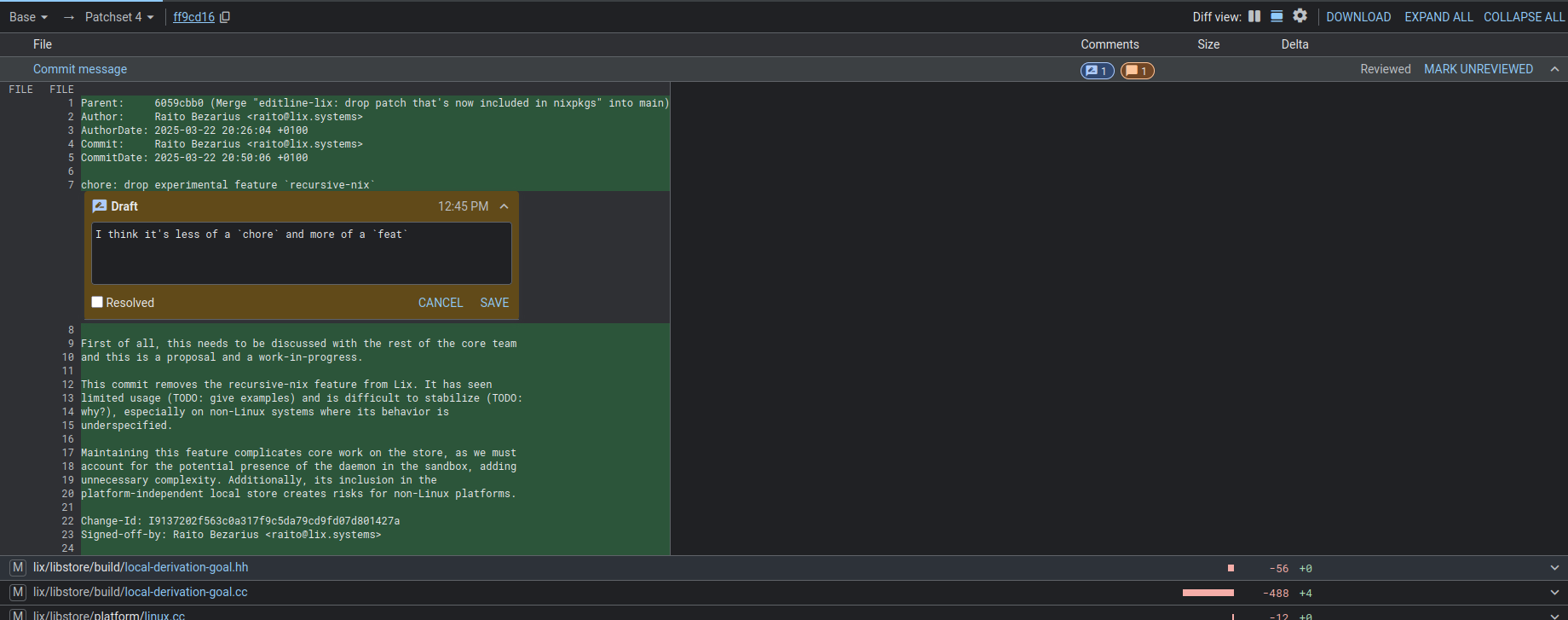
You can click on a line number to add a comment. Like on Github, the comments will be saved in a "draft" state, and will be submitted all at once when you finish the review.
When you expand the change to a file, the file will be marked as "reviewed" automatically - for your convenience. If you press "Expand All" button, you'll have to mark files as "reviewed" manually.
Finally, you can also change the "revisions" of comparison: you can choose to review the diff between Patchset [version] 3 and Patchset [version] 4! FIXME: this might be done automatically on re-review?
Finally, when the review is done, you scroll up and press the "Reply" button to submit a review, where you can add a final comment:
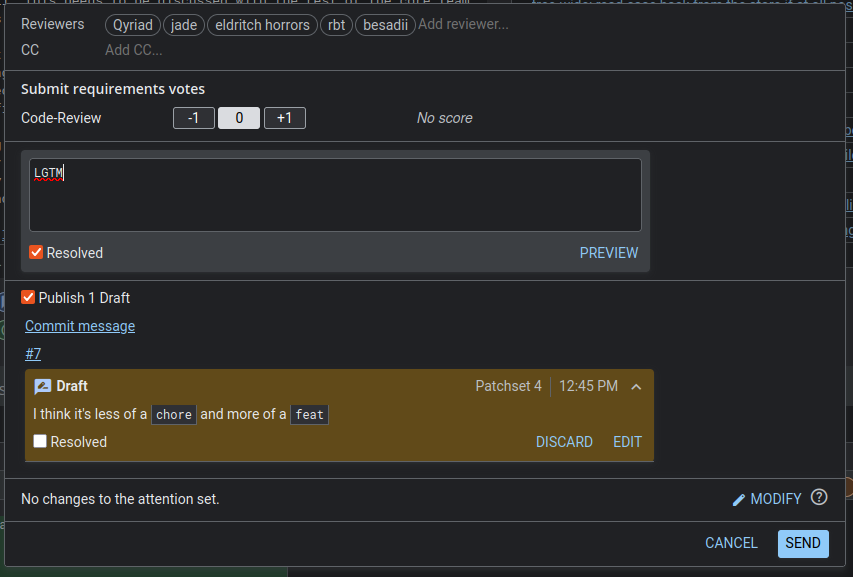
There, it's possible to mark some comments as resolved (maybe they're a non-important nitpick!), and also add a Code-Review vote. This is similar to Github's "approve/comment/request changes" on a PR, but a little more flexible. For a change to be ready for merge, it needs +2 on Code Review. Lix maintainers can +2 your change by themselves, so in normal circumstances, your change will require maintainer approval or 2 reviews from non-maintainers.
Reviewee Flow
There are two ways to view the review. One is to look at it directly in code:
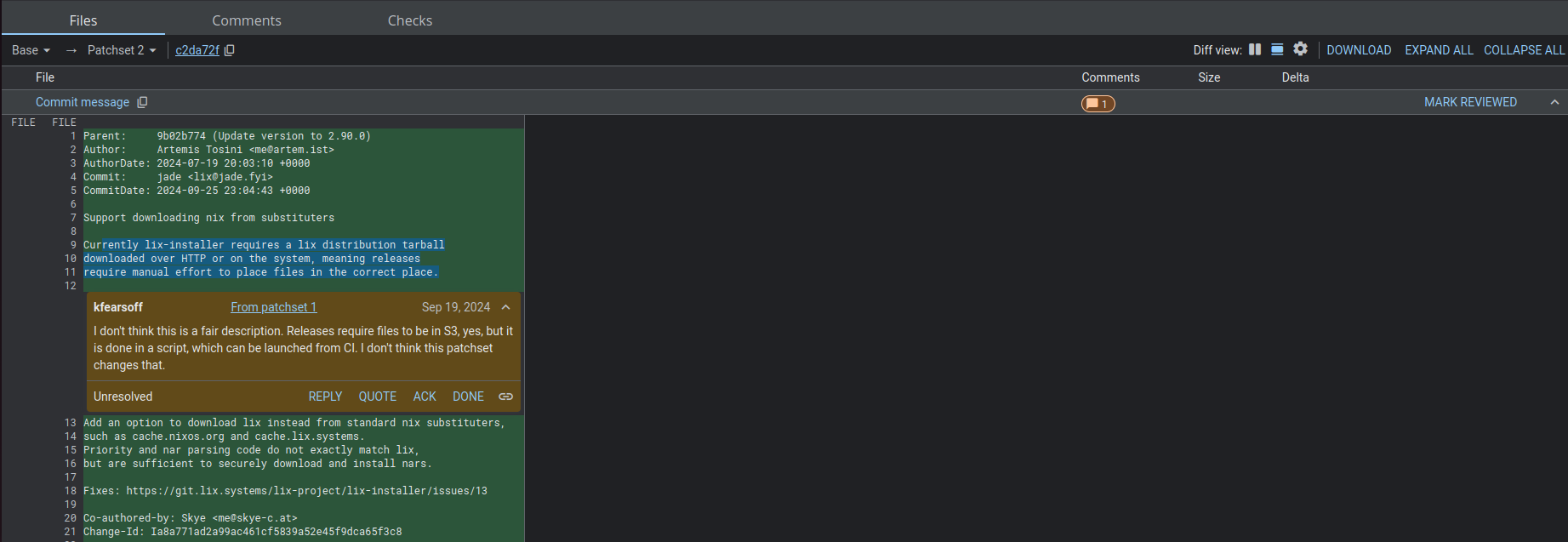
This will show you the whole comment thread.
Another way is to scroll down to the change log and expand a review:
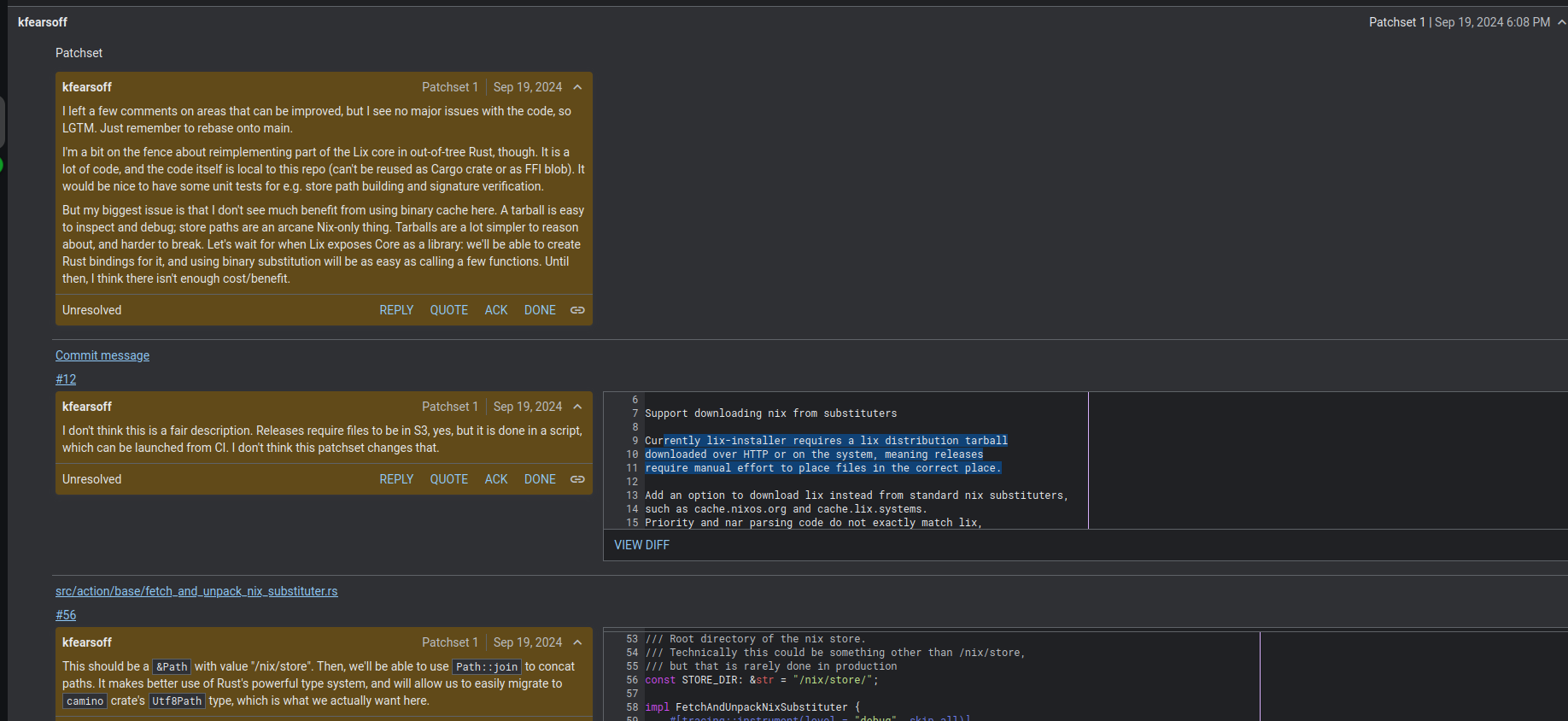
This will show you the entire review at once, with threads collapsed.
Choose whichever you like best!
Merge Flow
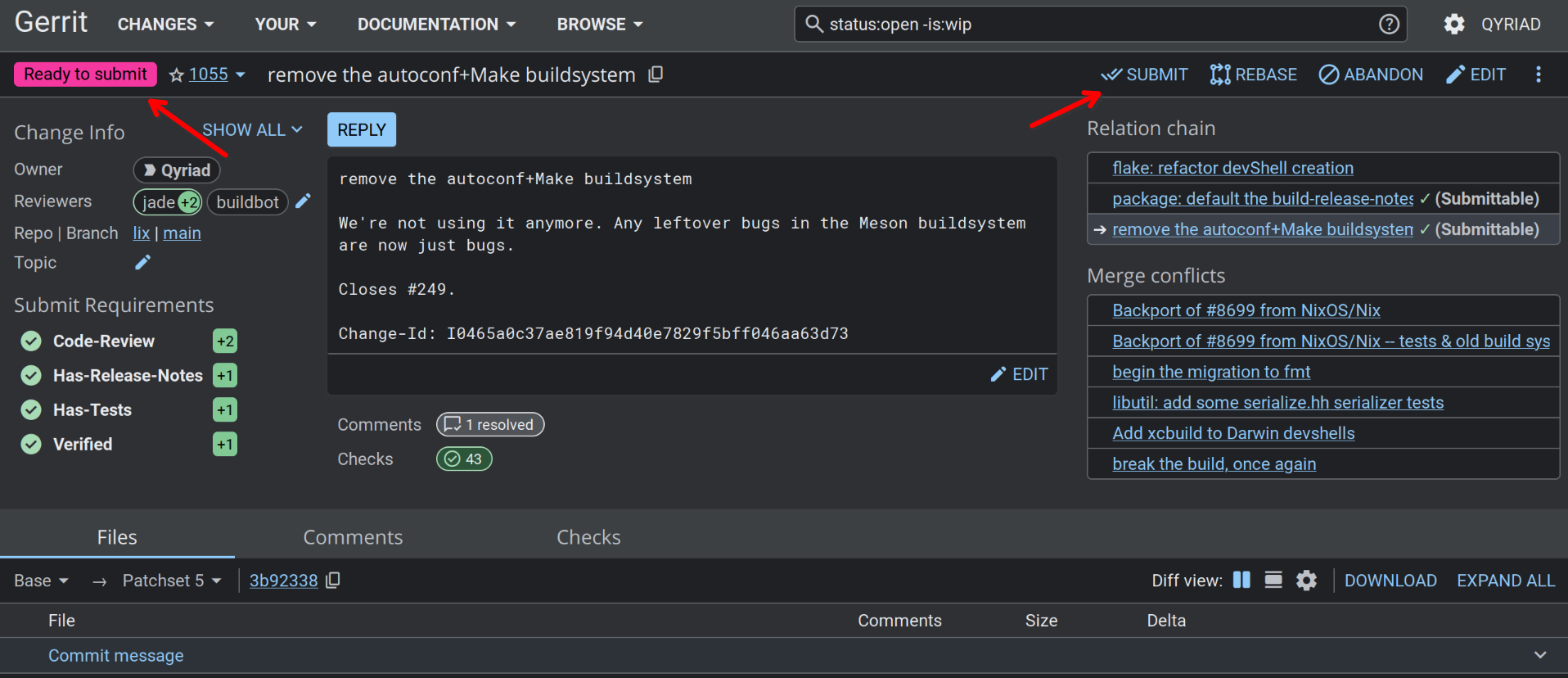
Once approved, the change can be merged. Maintainers will sometimes do that, but we generally prefer to leave the decision to the person who submitted the change! Take a final look at your change, verify that everything looks good, and press the "Submit" button!
Why Gerrit?
Gerrit produces better code:
- Gerrit enforces good commit messages. "PR message" and "commit message" are the same thing in Gerrit; there's no duplication, and information about a change can be seen in regular commit history.
- Gerrit enforces good commit hygiene, since adding another commit is really just splitting a commit with
git revise -cor other tools; since there are no PR dependencies or branches to worry about, splitting commits is no longer a big ask. - Relatedly, this directly makes reviews smaller since the overhead of doing another change is low.
Gerrit makes reviewers' lives easier and reduces review round trips:
- As a reviewer, you can look at what changed since you last reviewed, even in the presence of rebases, by looking at the patchset history of a CL. This avoids pointless rereview; you can actually diff versions of changes properly.
- The change author generally merges the change after approval, without them needing commit access. This means that they can do a final once-over of the change and make sure that they are ok with its state before merging it. This reduces miscommunication causing merging of unfinished code.
- As a reviewer, you can edit someone's change and/or commit message to fix a typo (in the web interface) and then stamp it, while giving them the final say on merging the edited change.
- You can give feedback like the following: "I would merge this as-is but you can consider this feedback if you would like" and then let the change author decide to merge it.
- Since the permission-requiring step in Gerrit is approving the change, not merging it, every change author can have final say in when the change gets merged.
- Review suggestions get applied as a batch without cluttering commit history in a confusing manner.
- You can download someone's change to look at it locally in one command that you can copy paste from the Gerrit interface (keyboard shortcut:
d).
Gerrit makes your life easier as a contributor:
- Submitting a new change is just a matter of committing it and pushing it. You don't need to think about branches or the web interface or extra commands. Want to do more changes building on it? Just commit them and push them.
- Branches are not required and you can easily build off of other peoples' changes by fetching them and rebasing against them; change dependencies are simply commit parents. They can then be merged in whichever manner they will be merged.
- If you are doing a larger change, it is natural to merge it piece by piece, adding little improvements as you go, and putting the highest risk parts of it at the tip, making the obviously good parts of the change land and keeping your diffs and rebases against main smaller.
- Gerrit makes it clear which comments still need action in a clean way, compared to GitHub where resolved comments get regularly broken or disappear altogether.
- Gerrit guesses (with reasonable accuracy) who a change is blocked on and shows it on the dashboard with a little arrow next to their name, allowing you to see at a glance which changes are your responsibility at a given time.
- There is a rebase button that just works. Trivial non-conflicting rebases do not require a rereview.
That being said, there are some downsides:
- Gerrit is very mean to you if you don't have your commit history in a clean presentable state, which takes some getting used to and Git does not make editing history easy, so it does involve a little more fighting of Git. However, this also means that the reviews can be of cleaner and smaller pieces of code with fewer unrelated changes.
- jujutsu fixes this: if you are finding an amend based workflow frustrating, we highly recommend using Jujutsu in place of Git. See Jujutsu usage with Gerrit for more details.
- This makes pushing work in progress code with questionable commit history harder; see below for solutions to this.
- Gerrit requires a little bit of local setup in the form of adding your SSH key or setting up the HTTP password. It also requires a Git commit-msg hook, but nix develop automatically does that for you.
Gerrit with Jujutsu
Jujutsu has a very similar model to Gerrit and natively supports sending Gerrit changes!
You’ll need to configure a Gerrit remote. If it’s not origin, you can instruct Jujutsu to use it by specifying it in .jj/repo/config.toml:
[gerrit]
default-remote = "gerrit"       # name of the Git remote to push to
default-remote-branch = "main"  # target branch in Gerrit
After that, jj gerrit upload -r <revision> will automatically add Change-Id footers and send your changes to Gerrit, printing a link to a resulting patchset to the terminal.
See Jujutsu docs for more information.
Tips and Tricks
SSH Tuning
Add these lines to your ~/.ssh/config:
Host gerrit.lix.systems
    User YOUR_GERRIT_USERNAME
    Port 2022
    # Keep sessions open for a bit in the background to make connections faster:
    ControlMaster auto
    ControlPath /tmp/ssh-%r@%h:%p
    ControlPersist 120
Now you can use ssh://gerrit.lix.systems/lix instead of ssh://USERNAME@gerrit.lix.systems:2022/lix URL, and have faster iterations on a change!
Splitting Commits
Sometimes a commit that was supposed to be a single feature gets out of hand. You have options. git rebase -i is a "default" suggestion, but you might want to look at git-revise or even at Jujutsu, which has a pretty cool squash workflow to do this!
Advanced Features
If you feel confident in your Gerrit-fu, this page is for you. Perhaps you've already noticed how Gerrit brings a few good improvements to the workflow just based on the commit-centric design. Now we are getting to the really cool stuff: Gerrit-specific features that further enhance your experience!
WIP Changes
Want to mark a change as WIP? You can do it in the Web UI. Or you can do it immediately on push:
git push origin HEAD:refs/for/main%wip
Submitting Chains of Changes
In traditional Git forges, it is hard to submit multiple changes to one repo at once. Perhaps you want to avoid unnecessary rebuilds - or broken intermediate states. You might have to coordinate with people, plan downtime, or create meta-PRs to do that.
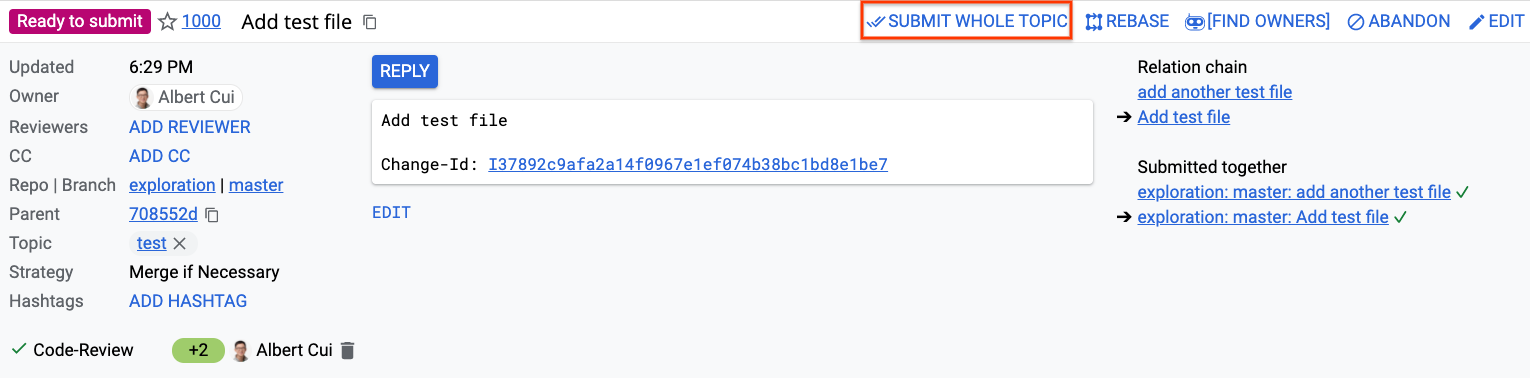
Thankfully, Gerrit has topics for that! Assign a topic to necessary CLs, or set it on push:
git push origin HEAD:refs/for/master%topic=<username>-<ISO8601 date>-<topic name>
For example:
git push origin HEAD:refs/for/master%topic=kfearsoff-2025-03-29-rebranding
Why the convoluted naming scheme? Unfortunately, Gerrit doesn't namespace topics, so we do a funny naming scheme to prevent accidental collisions. We are truly sorry for this.
Once all changes in a topic are reviewed, they can be gracefully sent all at once!
Syncing Multiple Repos
In traditional Git forges, it is always a huge pain when you need to submit a batch of changes at once to multiple repos.
Topics to the rescue, again! Just follow the instructions for chains of changes, but in multiple repos. Isn't that awesome?
Troubleshooting
"Remote Unpack Failed" on push
Run a git fetch and try again.
Re-run a CI
Do an empty commit amend: git commit --amend. This will change the commit ID (because the date has changed!), so it will now be a new CL revision: you can git push it and pray for good CI run!
Working in the Lix codebase
See also: https://git.lix.systems/lix-project/lix/src/branch/main/doc/manual/src/contributing/hacking.md
Codebase overview
The Lix system is constituted of two broad parts, the evaluator and the store daemon. The two pieces may run on the same machine or on different machines.
For example, in a remote build setup like https://hydra.nixos.org, one node is running several evaluators in parallel, and builds are dispatched to several builder nodes.
(fyi to anyone editing this, double click the image in the preview to edit it)

Evaluator
The evaluator is an AST tree-walking evaluator with lazy semantics.
Notable files:
- libexpr/value.hh, which defines the interface for evaluated values' interactions.
- libexpr/eval.cc, where most of the evaluator is.
-
libexpr/nixexpr.cc, where the most of the
nix::Exprclass hierarchy is implemented, which are the AST types for the evaluator. - libexpr/primops.cc, defining builtins.
- libexpr/parser.y, the (current) yacc generated parser.
- libexpr/lexer.l, the bison-generated lexer.
Known design flaws
- GC issues (FIXME add details)
- General tendencies to leak memory. Hydra restarts the evaluator every so often if it runs out of memory.
- AST based evaluator design limits perf
- Stack tracing has issues that make the traces confusing (FIXME add details)
- Funniness with attr ordering and equality that nixpkgs depends on, which is fragile
- Currently no real tools to diagnose this and stop nixpkgs from depending on it. https://github.com/NixOS/nix/pull/8711 exists but regresses perf a lot and is not mergeable.
- Evaluation-time build dependencies (often called IFD) block the evaluator rather than allowing other evaluation to proceed
- This has significant downstream effects such as typical derivations building hand-written large pieces rather than generated smaller pieces with IFD, since IFD is bad.
- The eval cache both has false hits and false misses, and needs redesign.
Lix team plans
- Rewrite parser (done, being ported for 2.91 by horrors)
- Rewrite evaluator to be amenable to moving to bytecode (horrors) (long term)
- Do something about GC (long term)
Store protocol
The store protocol is a hand rolled binary protocol with monotonically increasing versioning. It runs over a few different transports such as ssh (src/libstore/ssh-store.cc) or Unix sockets (src/libstore/uds-remote-store.cc).
Known design flaws
- We cannot extend the store protocol (not that it is Good) because of the monotonic version numbers: we must always be stuck at some released CppNix version. This significantly moves up the need to replace it.
- The code is significantly tangled with the current protocol design.
Lix team plans
- Replace protocol with capnproto, transport with websockets?
- Would likely be in addition to existing protocol; existing protocol likely would be run through a translator.
Store daemon
The store daemon takes derivations (≈ execve args and dependencies) and realises (builds or substitutes) them. It also implements store path garbage collection.
Lix's local store implementation currently uses a SQLite database as the source of truth for mapping derivation outputs to derivations as well as maintaining derivation metadata.
Notable files:
- libstore/build/local-derivation-goal.cc, which implements the local machine's builder including the sandbox
- libstore/build/entry-points.cc, the server side entry points of the store protocol
- libstore/daemon.cc
- libstore/uds-remote-store.cc, the client implementation of Unix socket stores
Known design flaws
- Sandbox is of dubious security especially on Linux (where it is actually expected to be somewhat secure)
- Overall tangled code around the sandbox, particularly in platform specific parts
- Poor self-awareness: daemon doesn't know what it is building
- Due to this plus the protocol being frozen, it would be very hard to implement e.g. dropping into a shell on failed builds
- Substitutions are inherently a kind of build so they can't happen out of dependency order or with better parallelism
- SQLite database has a habit of getting corrupted (probably due to Lix-side misuse)
Lix team plans
- Replace sandbox with other software, perhaps bwrap
- Fix daemon self-awareness, add protocol level features to make this better
- Rearchitect substitution to enqueue weakly ordered jobs that happen in parallel and can resume downloads
- Switch to xattrs as the source of truth of store path metadata such that the SQLite DB can be completely rebuilt
Freezes and recommended contributions
Suggested contributions
Consider taking an issue marked E-help wanted: assign it to yourself and have a go. Feel free to ask for help in the development channel. The Lix team wants these issues fixed, but they are not high on our agenda to fix ourselves.
When in doubt, please ask the Lix team before beginning work, to make sure it is in line with our current priorities.
I don't wanna write C++. How can I help?
This is totally reasonable, C++ is not super fun, but this isn't to say there isn't help if you do choose to. Nonetheless, there are still many issues on our tracker that do not require writing any C++ that would help out immensely.
Here's some possible places to look:
- docs issues on lix-project/lix. These generally involve writing documentation prose.
-
testing issues on lix-project/lix. A large number of these are just writing shell scripts, pytest scripts (
tests/functional2in lix), or fixing NixOS tests - external project issues. This is a veritable grab bag of issues in external projects that we would love to have fixed. There's some in Gerrit (Java), some in Forgejo (Go), some in meson (python), some in nixpkgs. It's unlikely these will get done without some help so we really appreciate help!
- website issues our homepage still need some love in various areas. It uses Hugo as a static site generator, so contributing requires little more than some basic HTML and CSS skills.
New builtins
One thing that is a little bit tricky and can get contributions canned late in the process is new builtins. We should write up a more full document on this, but the gist is that the API of any builtins needs to stand the test of time as they have pretty strong compatibility and usefulness expectations.
As such, it would be greatly appreciated if work on builtins starts with an issue on lix-project/lix tagged RFD discussing the use case for the builtin, then, once there is rough agreement on the use case, write a simple document giving examples and design of the proposed API. Then, we can gather feedback before too much time is put into implementations that might not see the light of day.
Freezes
We expect to have main always be in a state to run on machines you care about, unconditionally. Nightly builds should not be a problem to run in production in any freeze state.
For the time being, Flakes are frozen in their current feature set and will only receive maintenance bug fixes.
Bug tracker organisation
We have a repo of directly imported nix bugs at https://git.lix.systems/nixos/nix. Please don't file bugs in there, we want the IDs to match. When we import a bug, we might put notes on there as we triage it, and potentially close it.
Bug labels on NixOS/nix
-
lix-import - Should be imported, we think it is still a bug
-
lix-ignore - We don't care about this bug, it probably doesn't affect us
-
lix-stability - Fixing this would improve the stability and reliability of Lix.
Dispositions:
- lix-norepro - Tried repro on upstream 2.18.1 and did not repro
- lix-retest-after-backports - Request that this be tested again once backports are done
- lix-reproduces-2.18 - Confirmed to repro in 2.18.
- lix-unclear-repro - Unsure how to repro but believe it affects lix
- lix-closed-libgit2 - Caused by libgit2
- lix-closed-lazy-trees - Caused by lazy trees
Closed, marginal
- post-build-hook doesn't print a warning if not trusted-user https://git.lix.systems/NixOS/nix/issues/9790#issuecomment-273
- complaints about builtins.derivation https://git.lix.systems/NixOS/nix/issues/9774
- rejecting flake config still asks for confirm again https://git.lix.systems/NixOS/nix/issues/9788
- complaints of "substituter disabled", but is their bin cache just broken? https://git.lix.systems/NixOS/nix/issues/9749
- warn on eol https://git.lix.systems/NixOS/nix/issues/9556
Gerrit
FIXME: this page is duplicating a lot of content from the Gerrit section and should be considered deprecated
See the Gerrit section in this book for newer pages.
TODO: "Workflow tips" section seems to have got mangled in that transition and needs migration.
What is Gerrit and why do people like it?
Gerrit is a code review system from Google in a similar style to Google's internal Critique tool, but based on Git, and publicly available as open source. It hosts a Git repo with the ability to submit changes for review and offers mirroring to other repos (like https://git.lix.systems/lix-project/lix). It has an entirely different review model to GitHub (and Forgejo, GitLab, etc that copy GitHub's review model), where, instead of pull requests, you have changelists (CLs): reviews on individual commits, with each revision of a commit being a different "patchset", rather than reviewing an entire branch at a time. CLs may be merged one by one or in a batch.
Although this has some learning curve, we expect that you will find it pleasant to work with after figuring it out. It has some rough edges and strong opinions that take some getting used to, but it has served us well and saved us an inordinate amount of time both as reviewers and change authors. The rest of this document gives some pointers on the workflows we use with Gerrit.
People like Gerrit because it makes the following things trivial or easy, all of which are somewhere between annoying and impossible on GitHub modeled systems:
Gerrit produces better code:
- Gerrit enforces good commit messages, since there is no second "pr message" so peoples' commit messages get actually looked at with some care
- Gerrit enforces good commit hygiene, since adding another commit is really just splitting a commit with
git revise -cor other tools; since there are no PR dependencies or branches to worry about, splitting commits is no longer a big ask.- Relatedly, this directly makes reviews smaller since the overhead of doing another change is low.
Gerrit makes reviewers' lives easier and reduces review round trips:
- As a reviewer, you can look at what changed since you last reviewed, even in the presence of rebases, by looking at the patchset history of a CL. This avoids pointless rereview; you can actually diff versions of changes properly.
- The change author generally merges the change after approval, without them needing commit access. This means that they can do a final once-over of the change and make sure that they are ok with its state before merging it. This reduces miscommunication causing merging of unfinished code.
- As a reviewer, you can edit someone's change and/or commit message to fix a typo (in the web interface) and then stamp it, while giving them the final say on merging the edited change.
- You can give feedback like the following: "I would merge this as-is but you can consider this feedback if you would like" and then let the change author decide to merge it.
- Since the permission-requiring step in Gerrit is approving the change, not merging it, every change author can have final say in when the change gets merged.
- Review suggestions get applied as a batch without cluttering commit history in a confusing manner.
- You can download someone's change to look at it locally in one command that you can copy paste from the Gerrit interface.
Gerrit makes your life easier as a contributor:
- Submitting a new change is just a matter of committing it and pushing it. You don't need to think about branches or the web interface or extra commands. Want to do more changes building on it? Just commit them and push them.
- Branches are not required and you can easily build off of other peoples' changes by fetching them and rebasing against them; change dependencies are simply commit parents. They can then be merged in whichever manner they will be merged.
- If you are doing a larger change, it is natural to merge it piece by piece, adding little improvements as you go, and putting the highest risk parts of it at the tip, making the obviously good parts of the change land and keeping your diffs and rebases against
mainsmaller. - Gerrit makes it clear which comments still need action in a clean way, compared to GitHub where resolved comments get regularly broken or disappear altogether.
- Gerrit guesses (with reasonable accuracy) who a change is blocked on and shows it on the dashboard with a little arrow next to their name, allowing you to see at a glance which changes are your responsibility at a given time.
- There is a rebase button that just works. Trivial non-conflicting rebases do not require a rereview.
That being said, there are some downsides:
- Gerrit is very mean to you if you don't have your commit history in a clean presentable state, which takes some getting used to and Git does not make editing history easy, so it does involve a little more fighting of Git. However, this also means that the reviews can be of cleaner and smaller pieces of code with fewer unrelated changes.
- This makes pushing work in progress code with questionable commit history harder; see below for solutions to this.
- jujutsu fixes this: if you are finding an amend based workflow frustrating, we highly recommend using Jujutsu in place of Git. See Jujutsu usage with Gerrit for more details.
- Gerrit requires a little bit of local setup in the form of adding your SSH key or setting up the HTTP password. It also requires a Git commit-msg hook, but
nix developautomatically does that for you.
Learning materials
- https://gerrit-review.googlesource.com/Documentation/intro-user.html
- https://docs.google.com/presentation/d/1C73UgQdzZDw0gzpaEqIC6SPujZJhqamyqO1XOHjH-uk/view
Our installation
Gerrit is at https://gerrit.lix.systems
The Gerrit SSH server is running on port 2022. The repo URLs are:
-
ssh://{username}@gerrit.lix.systems:2022/lix -
https://gerrit.lix.systems/lixif using HTTP auth; see Gerrit settings for setting an HTTP password if desired
Hit the d key on any change to download it, which will give you the right URLs.
SSH config
You might like to add the following configuration to your ~/.ssh/config:
Host gerrit.lix.systems
    User YOUR_GERRIT_USERNAME
    Port 2022
    # Keep sessions open for a bit in the background to make connections faster:
    ControlMaster auto
    ControlPath /tmp/ssh-%r@%h:%p
    ControlPersist 120
Basic workflow for a change
The unit of code review is a "change", which yields a single commit when "submitted" (merged). The commit message is taken from the change description in Gerrit; in our experience this tends to lead to more comprehensive commit messages.
For a change to be merged, it must have the following four "votes", in Gerrit's terminology:
- Set by reviewers:
- +2 Code-Review: the committer that reviewed this thinks it can be submitted as-is (all users can vote +1/-1, expressing a weaker view on code acceptability)
- +1 Has-Release-Notes: means the reviewer thinks your commit added relevant release notes for that commit, or that it does not need any. This serves primarily as a reminder.
- +1 Has-Tests: means the reviewer thinks your commit added all the tests that commit needs, or that it does not need additional tests. Like Has-Release-Notes, this serves primarily as a reminder.
- Set automatically by CI:
- +1 Verified: means CI successfully built for all our platforms and passed all tests
If you're newly part of the core team you will need to add yourself to the Gerrit lix group, otherwise you can't set the Has-Release-Notes or Has-Tests labels. If you're not, this doesn't affect you.
When all of those labels are set, a change becomes Ready to submit, in Gerrit's termology, and Gerrit will give you a Submit button in the top right:
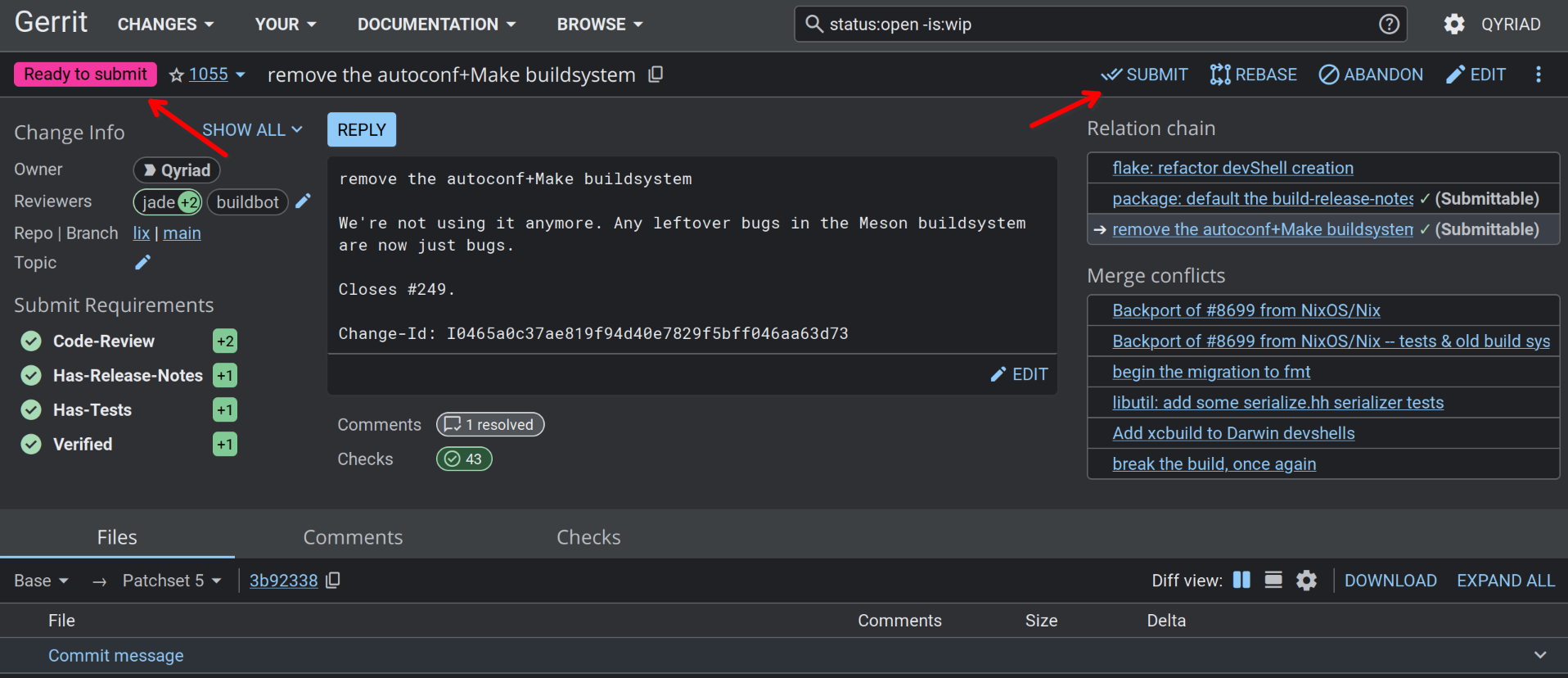
By convention, the change author has the final say on clicking the Submit button (note: this is the opposite of the Github convention), and there is no special permission to merge a change once it has been fully reviewed (the permissions are in the reviewer +2'ing it). This gives you a last chance to have a look at your change before merging it.
Workflow tips
Local branches and commits
Gerrit is very mean to you if you don't have your local commit history in a linear presentable state, which takes getting used to but it is very low overhead once you get used to it. In short, amended commits become "patchsets", new commits become changes, and multiple commits help link your changes together as a "relation chain".
Note: if you're coming from Chromium, this is different to how they use Gerrit, where multiple commits become patchsets, and only the first commit on a local branch creates a new change.
Gerrit’s commit-msg hook generates a new Change-Id for each commit you make, which in turn creates a new change that gets reviewed separately. To update an existing change after review feedback, amend or squash your changes into your old commit, keeping its Change-Id unchanged, then push.
Consider not pushing for review before it is clean, or split commits up with git-revise (good) or jj (better) after the fact, amending as you work. If you want a backup of your changes, you can fork it on Forgejo and push to that fork.
Basic Pushing
If you cloned the repo from Forgejo, be sure to change your remote URL to point to Gerrit before continuing.
Assuming your remote is called origin (which is the default):
git remote set-url origin ssh://{username}@gerrit.lix.systems:2022/lix
Then you can push to Gerrit with:
git push origin HEAD:refs/for/main
If you get tired of doing this every time, you can automate it by setting the .git/config as follows:
git config remote.origin.push HEAD:refs/for/main
You will have to do that in each fresh check-out. Once it's done, git push will work without additional options.
If you get a “remote unpack failed” error while pushing, run git fetch then try again.
If you wish to push a change and immediately mark it as WIP, you can push with -o wip, or make that the default behavior by checking Set new changes to "work in progress" by default in Gerrit's user settings, under "Preferences".
Topics & Push Arguments
A Gerrit topic may be set on push with:
git push origin HEAD:refs/for/main%topic=foo
Which will create all pushed changes with the topic "foo". Topics are helpful for grouping long series of related changes.
A change may also be marked as "work in progress" on push:
git push origin HEAD:refs/for/main%wip
Gerrit has documentation on other push arguments you can use here, but it also takes a help argument whose output is more canonical and might be easier to understand, which you can view with:
git push origin HEAD:refs/for/main%help
At the time of this writing (2024/06/26), that output looks like this:
$ git push origin @:refs/for/main%help
Total 0 (delta 0), reused 0 (delta 0), pack-reused 0 (from 0)
remote: Processing changes: refs: 1, done
remote:
remote: Help for refs/for/branch:
remote:
remote:  --base BASE                            : merge base of changes
remote:  --cc CC                                : add CC to changes
remote:  --create-cod-token                     : create a token for consistency-on-dema
remote:                                           nd (default: false)
remote:  --deadline NAME                        : deadline after which the push should
remote:                                           be aborted
remote:  --edit (-e)                            : upload as change edit (default: false)
remote:  --hashtag (-t) HASHTAG                 : add hashtag to changes
remote:  --help (-h)                            : display this help text (default: true)
remote:  --ignore-automatic-attention-set-rules : do not change the attention set on
remote:  (-ias, -ignore-attention-set)            this push (default: false)
remote:  --label (-l) LABEL+VALUE               : label(s) to assign (defaults to +1 if
remote:                                           no value provided)
remote:  --merged                               : create single change for a merged
remote:                                           commit (default: false)
remote:  --message (-m) MESSAGE                 : Comment message to apply to the review
remote:  --no-publish-comments (--np)           : do not publish draft comments
remote:                                           (default: false)
remote:  --notify [NONE | OWNER |               : Notify handling that defines to whom
remote:  OWNER_REVIEWERS | ALL]                   email notifications should be sent.
remote:                                           Allowed values are NONE, OWNER,
remote:                                           OWNER_REVIEWERS, ALL. If not set, the
remote:                                           default is ALL.
remote:  --notify-bcc USER                      : user that should be BCC'd one time by
remote:                                           email
remote:  --notify-cc USER                       : user that should be CC'd one time by
remote:                                           email
remote:  --notify-to USER                       : user that should be notified one time
remote:                                           by email
remote:  --private                              : mark new/updated change as private
remote:                                           (default: false)
remote:  --publish-comments                     : publish all draft comments on updated
remote:                                           changes (default: false)
remote:  --ready                                : mark change as ready (default: false)
remote:  --remove-private                       : remove privacy flag from updated
remote:                                           change (default: false)
remote:  --reviewer (-r) REVIEWER               : add reviewer to changes
remote:  --skip-validation                      : skips commit validation (default:
remote:                                           false)
remote:  --submit                               : immediately submit the change
remote:                                           (default: false)
remote:  --topic NAME                           : attach topic to changes
remote:  --trace NAME                           : enable tracing
remote:  --wip (-work-in-progress)              : mark change as work in progress
remote:                                           (default: false)
remote:
To ssh://gerrit.lix.systems:2022/lix
 ! [remote rejected]     HEAD -> refs/for/main%help (see help)
error: failed to push some refs to 'ssh://gerrit.lix.systems:2022/lix'
Pulling
Pulling from Gerrit will work normally. It's worth keeping in mind that sometimes a CL you're working on has been edited in the web UI or by another contributor, so the commit in your repo isn't the latest. Rebasing will usually make the duplicate go away; this is part of the normal rebase semantics, not Gerrit magic. You might consider making rebase-on-pull your default.
Sandbox branches
This feature has some notable ways to shoot yourself in the foot. We still support it, since it allows for running CI builds on things before they become proper CLs. If you don't need that and don't want to worry about the footguns, consider using a branch on a Forgejo fork for sharing WIP code.
In particular, if a commit is in any branch already including a sb/ branch, it will be rejected with the error "no new changes" if it is later pushed to refs/for/main. This can be worked around by amending all the commits so they are distinct, or by git push origin HEAD:refs/for/main%base=$(git rev-parse origin/main), which forces the merge-base
Use refs/heads/sb/USERNAME/*.
CI rerun
Push the CL again with a no-changes commit amendment if you want to force CI to rerun.
Finding CLs to review
Consider bookmarking: https://gerrit.lix.systems/q/status:open+-is:wip+-author:me+label:Code-Review%3C2
Improving build times
Setup
Use a clang stdenv:
nix develop .#native-clangStdenvPackages
Then delete build/ if you were using gcc before. Enable build-time profiling with:
just setup; meson configure build -Dprofile-build=enabled
Then run the build: just compile.
Enabling build-time profiling itself costs about 10% of compile time but has no other disadvantage.
Build time reports
Use maintainers/buildtime_report.sh build/ to generate a build time report. This will tell you where all our build time went by looking at the trace files and producing a badness summary.
Sample report
Build-time report sample
lix/lix2 » ClangBuildAnalyzer --analyze buildtimeold.bin
Analyzing build trace from 'buildtimeold.bin'...
**** Time summary:
Compilation (551 times):
  Parsing (frontend):         1465.3 s
  Codegen & opts (backend):   1110.9 s

**** Files that took longest to parse (compiler frontend):
 10478 ms: build/src/libstore/liblixstore.so.p/build_local-derivation-goal.cc.o
 10319 ms: build/src/libexpr/liblixexpr.so.p/primops.cc.o
  9947 ms: build/src/nix/nix.p/flake.cc.o
  9850 ms: build/src/libexpr/liblixexpr.so.p/eval.cc.o
  9751 ms: build/src/nix/nix.p/profile.cc.o
  9643 ms: build/src/nix/nix.p/develop.cc.o
  9296 ms: build/src/libcmd/liblixcmd.so.p/installable-attr-path.cc.o
  9286 ms: build/src/libstore/liblixstore.so.p/build_derivation-goal.cc.o
  9208 ms: build/src/libcmd/liblixcmd.so.p/installables.cc.o
  9007 ms: build/src/nix/nix.p/.._nix-env_nix-env.cc.o

**** Files that took longest to codegen (compiler backend):
 24226 ms: build/src/libexpr/liblixexpr.so.p/primops_fromTOML.cc.o
 24019 ms: build/src/libexpr/liblixexpr.so.p/primops.cc.o
 21102 ms: build/src/libstore/liblixstore.so.p/build_local-derivation-goal.cc.o
 16246 ms: build/src/libstore/liblixstore.so.p/store-api.cc.o
 14586 ms: build/src/nix/nix.p/.._nix-build_nix-build.cc.o
 13746 ms: build/src/libexpr/liblixexpr.so.p/eval.cc.o
 13287 ms: build/src/libstore/liblixstore.so.p/binary-cache-store.cc.o
 13263 ms: build/src/nix/nix.p/profile.cc.o
 12970 ms: build/src/nix/nix.p/develop.cc.o
 12621 ms: build/src/libfetchers/liblixfetchers.so.p/github.cc.o

**** Templates that took longest to instantiate:
 42922 ms: nlohmann::basic_json<>::parse<const char *> (69 times, avg 622 ms)
 32180 ms: nlohmann::detail::parser<nlohmann::basic_json<>, nlohmann::detail::i... (69 times, avg 466 ms)
 27337 ms: nix::HintFmt::HintFmt<nix::Uncolored<std::basic_string<char>>> (246 times, avg 111 ms)
 25338 ms: nlohmann::basic_json<>::basic_json (293 times, avg 86 ms)
 23641 ms: nlohmann::detail::parser<nlohmann::basic_json<>, nlohmann::detail::i... (69 times, avg 342 ms)
 20203 ms: boost::basic_format<char>::basic_format (492 times, avg 41 ms)
 17174 ms: nlohmann::basic_json<>::json_value::json_value (368 times, avg 46 ms)
 15603 ms: boost::basic_format<char>::parse (246 times, avg 63 ms)
 13268 ms: std::basic_regex<char>::_M_compile (28 times, avg 473 ms)
 12757 ms: std::__detail::_Compiler<std::regex_traits<char>>::_Compiler (28 times, avg 455 ms)
 10813 ms: std::__detail::_Compiler<std::regex_traits<char>>::_M_disjunction (28 times, avg 386 ms)
 10719 ms: std::__detail::_Compiler<std::regex_traits<char>>::_M_alternative (28 times, avg 382 ms)
 10508 ms: std::__detail::_Compiler<std::regex_traits<char>>::_M_term (28 times, avg 375 ms)
  9516 ms: nlohmann::detail::json_sax_dom_callback_parser<nlohmann::basic_json<... (69 times, avg 137 ms)
  9112 ms: std::__detail::_Compiler<std::regex_traits<char>>::_M_atom (28 times, avg 325 ms)
  8683 ms: std::basic_regex<char>::basic_regex (18 times, avg 482 ms)
  8241 ms: std::operator<=> (438 times, avg 18 ms)
  7561 ms: std::vector<boost::io::detail::format_item<char, std::char_traits<ch... (246 times, avg 30 ms)
  7475 ms: std::vector<boost::io::detail::format_item<char, std::char_traits<ch... (246 times, avg 30 ms)
  7309 ms: std::reverse_iterator<std::_Bit_iterator> (268 times, avg 27 ms)
  7131 ms: boost::stacktrace::basic_stacktrace<>::basic_stacktrace (246 times, avg 28 ms)
  6868 ms: boost::stacktrace::basic_stacktrace<>::init (246 times, avg 27 ms)
  6518 ms: std::reverse_iterator<std::_Bit_const_iterator> (268 times, avg 24 ms)
  5716 ms: std::__detail::_Synth3way::operator()<std::variant<nix::OutputsSpec:... (182 times, avg 31 ms)
  5303 ms: nix::make_ref<nix::SingleDerivedPath, nix::DerivedPathOpaque> (178 times, avg 29 ms)
  5244 ms: std::__uninitialized_move_a<boost::io::detail::format_item<char, std... (246 times, avg 21 ms)
  4857 ms: std::make_shared<nix::SingleDerivedPath, nix::DerivedPathOpaque> (178 times, avg 27 ms)
  4813 ms: std::__detail::_Synth3way::operator()<std::variant<nix::TextIngestio... (158 times, avg 30 ms)
  4648 ms: nlohmann::detail::json_sax_dom_callback_parser<nlohmann::basic_json<... (69 times, avg 67 ms)
  4597 ms: std::basic_regex<char>::basic_regex<std::char_traits<char>, std::all... (10 times, avg 459 ms)

**** Template sets that took longest to instantiate:
 55715 ms: std::__do_visit<$> (3603 times, avg 15 ms)
 47739 ms: std::__detail::__variant::__gen_vtable_impl<$>::__visit_invoke (11132 times, avg 4 ms)
 43338 ms: nlohmann::basic_json<$>::parse<$> (85 times, avg 509 ms)
 43097 ms: std::__detail::__variant::__raw_idx_visit<$> (2435 times, avg 17 ms)
 32390 ms: nlohmann::detail::parser<$>::parse (83 times, avg 390 ms)
 30986 ms: nix::HintFmt::HintFmt<$> (1261 times, avg 24 ms)
 30255 ms: std::__and_<$> (25661 times, avg 1 ms)
 29762 ms: std::unique_ptr<$> (2116 times, avg 14 ms)
 28609 ms: std::__tuple_compare<$>::__eq (2978 times, avg 9 ms)
 27560 ms: nlohmann::detail::parser<$>::sax_parse_internal<$> (167 times, avg 165 ms)
 27239 ms: std::variant<$> (1959 times, avg 13 ms)
 26837 ms: std::__invoke_result<$> (10782 times, avg 2 ms)
 25972 ms: std::tuple<$> (5714 times, avg 4 ms)
 24247 ms: std::__uniq_ptr_data<$> (2116 times, avg 11 ms)
 24061 ms: std::__result_of_impl<$> (9029 times, avg 2 ms)
 23949 ms: std::__uniq_ptr_impl<$> (2116 times, avg 11 ms)
 21185 ms: std::optional<$> (2502 times, avg 8 ms)
 21044 ms: std::pair<$> (4989 times, avg 4 ms)
 20852 ms: std::__or_<$> (24005 times, avg 0 ms)
 20203 ms: boost::basic_format<$>::basic_format (492 times, avg 41 ms)
 20184 ms: std::tie<$> (2895 times, avg 6 ms)
 19938 ms: nlohmann::basic_json<$>::create<$> (668 times, avg 29 ms)
 19798 ms: std::allocator_traits<$>::construct<$> (5720 times, avg 3 ms)
 19182 ms: std::__detail::__variant::_Variant_base<$> (1959 times, avg 9 ms)
 19151 ms: std::_Rb_tree<$>::_M_erase (2320 times, avg 8 ms)
 19094 ms: std::_Rb_tree<$>::~_Rb_tree (2022 times, avg 9 ms)
 18735 ms: nlohmann::basic_json<$>::basic_json (243 times, avg 77 ms)
 18546 ms: std::__detail::_Synth3way::_S_noexcept<$> (2542 times, avg 7 ms)
 17174 ms: nlohmann::basic_json<$>::json_value::json_value (368 times, avg 46 ms)
 17111 ms: nlohmann::detail::conjunction<$> (907 times, avg 18 ms)

**** Functions that took longest to compile:
  2091 ms: _GLOBAL__sub_I_primops.cc (../src/libexpr/primops.cc)
  1799 ms: nix::fetchers::GitInputScheme::fetch(nix::ref<nix::Store>, nix::fetc... (../src/libfetchers/git.cc)
  1388 ms: nix::Settings::Settings() (../src/libstore/globals.cc)
  1244 ms: main_nix_build(int, char**) (../src/nix-build/nix-build.cc)
  1021 ms: nix::LocalDerivationGoal::startBuilder() (../src/libstore/build/local-derivation-goal.cc)
   918 ms: nix::LocalStore::LocalStore(std::map<std::__cxx11::basic_string<char... (../src/libstore/local-store.cc)
   835 ms: opQuery(Globals&, std::__cxx11::list<std::__cxx11::basic_string<char... (../src/nix-env/nix-env.cc)
   733 ms: nix::daemon::performOp(nix::daemon::TunnelLogger*, nix::ref<nix::Sto... (../src/libstore/daemon.cc)
   589 ms: _GLOBAL__sub_I_tests.cc (../tests/unit/libutil/tests.cc)
   578 ms: main_build_remote(int, char**) (../src/build-remote/build-remote.cc)
   522 ms: nix::fetchers::MercurialInputScheme::fetch(nix::ref<nix::Store>, nix... (../src/libfetchers/mercurial.cc)
   521 ms: nix::LocalDerivationGoal::registerOutputs[abi:cxx11]() (../src/libstore/build/local-derivation-goal.cc)
   461 ms: nix::getNameFromURL_getNameFromURL_Test::TestBody() (../tests/unit/libutil/url-name.cc)
   440 ms: nix::Installable::build2(nix::ref<nix::Store>, nix::ref<nix::Store>,... (../src/libcmd/installables.cc)
   392 ms: nix::prim_fetchClosure(nix::EvalState&, nix::PosIdx, nix::Value**, n... (../src/libexpr/primops/fetchClosure.cc)
   390 ms: nix::NixArgs::NixArgs() (../src/nix/main.cc)
   388 ms: update(std::set<std::__cxx11::basic_string<char, std::char_traits<ch... (../src/nix-channel/nix-channel.cc)
   340 ms: _GLOBAL__sub_I_primops.cc (../tests/unit/libexpr/primops.cc)
   332 ms: nix::flake::lockFlake(nix::EvalState&, nix::FlakeRef const&, nix::fl... (../src/libexpr/flake/flake.cc)
   305 ms: _GLOBAL__sub_I_lockfile.cc (../src/libexpr/flake/lockfile.cc)
   300 ms: nix_store::opQuery(std::__cxx11::list<std::__cxx11::basic_string<cha... (../src/nix-store/nix-store.cc)
   296 ms: nix::parseFlakeRefWithFragment(std::__cxx11::basic_string<char, std:... (../src/libexpr/flake/flakeref.cc)
   289 ms: _GLOBAL__sub_I_error_traces.cc (../tests/unit/libexpr/error_traces.cc)
   278 ms: nix::ErrorTraceTest_genericClosure_Test::TestBody() (../tests/unit/libexpr/error_traces.cc)
   274 ms: CmdDevelop::run(nix::ref<nix::Store>, nix::ref<nix::Installable>) (../src/nix/develop.cc)
   269 ms: nix::flake::lockFlake(nix::EvalState&, nix::FlakeRef const&, nix::fl... (../src/libexpr/flake/flake.cc)
   257 ms: nix::NixRepl::processLine(std::__cxx11::basic_string<char, std::char... (../src/libcmd/repl.cc)
   251 ms: nix::derivationStrictInternal(nix::EvalState&, std::__cxx11::basic_s... (../src/libexpr/primops.cc)
   249 ms: toml::result<toml::basic_value<toml::discard_comments, std::unordere... (../src/libexpr/primops/fromTOML.cc)
   238 ms: nix::LocalDerivationGoal::runChild() (../src/libstore/build/local-derivation-goal.cc)

**** Function sets that took longest to compile / optimize:
 10243 ms: std::vector<$>::_M_fill_insert(__gnu_cxx::__normal_iterator<$>, unsi... (190 times, avg 53 ms)
  9752 ms: bool boost::io::detail::parse_printf_directive<$>(__gnu_cxx::__norma... (190 times, avg 51 ms)
  8377 ms: void boost::io::detail::put<$>(boost::io::detail::put_holder<$> cons... (191 times, avg 43 ms)
  5863 ms: boost::basic_format<$>::parse(std::__cxx11::basic_string<$> const&) (190 times, avg 30 ms)
  5660 ms: std::vector<$>::_M_fill_insert(std::_Bit_iterator, unsigned long, bo... (190 times, avg 29 ms)
  4264 ms: non-virtual thunk to boost::wrapexcept<$>::~wrapexcept() (549 times, avg 7 ms)
  4023 ms: std::_Rb_tree<$>::_M_erase(std::_Rb_tree_node<$>*) (1238 times, avg 3 ms)
  3715 ms: boost::stacktrace::detail::to_string_impl_base<boost::stacktrace::de... (166 times, avg 22 ms)
  3705 ms: std::vector<$>::_M_fill_assign(unsigned long, boost::io::detail::for... (190 times, avg 19 ms)
  3326 ms: boost::basic_format<$>::str[abi:cxx11]() const (144 times, avg 23 ms)
  3070 ms: void boost::io::detail::mk_str<$>(std::__cxx11::basic_string<$>&, ch... (191 times, avg 16 ms)
  2839 ms: boost::basic_format<$>::make_or_reuse_data(unsigned long) (190 times, avg 14 ms)
  2321 ms: std::__cxx11::basic_string<$>::_M_replace(unsigned long, unsigned lo... (239 times, avg 9 ms)
  2213 ms: std::_Rb_tree<$>::_M_get_insert_hint_unique_pos(std::_Rb_tree_const_... (203 times, avg 10 ms)
  2200 ms: boost::wrapexcept<$>::~wrapexcept() (549 times, avg 4 ms)
  2093 ms: std::vector<$>::~vector() (574 times, avg 3 ms)
  1894 ms: bool std::__detail::_Compiler<$>::_M_expression_term<$>(std::__detai... (112 times, avg 16 ms)
  1871 ms: int boost::io::detail::upper_bound_from_fstring<$>(std::__cxx11::bas... (190 times, avg 9 ms)
  1867 ms: boost::wrapexcept<$>::clone() const (549 times, avg 3 ms)
  1824 ms: std::_Rb_tree_iterator<$> std::_Rb_tree<$>::_M_emplace_hint_unique<$... (244 times, avg 7 ms)
  1821 ms: toml::result<$> toml::detail::sequence<$>::invoke<$>(toml::detail::l... (93 times, avg 19 ms)
  1814 ms: nlohmann::json_abi_v3_11_2::detail::serializer<$>::dump(nlohmann::js... (39 times, avg 46 ms)
  1799 ms: nix::fetchers::GitInputScheme::fetch(nix::ref<$>, nix::fetchers::Inp... (1 times, avg 1799 ms)
  1771 ms: boost::io::detail::format_item<char, std::char_traits<char>, std::al... (190 times, avg 9 ms)
  1762 ms: std::__detail::_BracketMatcher<$>::_BracketMatcher(std::__detail::_B... (112 times, avg 15 ms)
  1760 ms: std::_Function_handler<$>::_M_manager(std::_Any_data&, std::_Any_dat... (981 times, avg 1 ms)
  1733 ms: std::__detail::_Compiler<$>::_M_quantifier() (28 times, avg 61 ms)
  1694 ms: std::__cxx11::basic_string<$>::_M_mutate(unsigned long, unsigned lon... (251 times, avg 6 ms)
  1650 ms: std::vector<$>::vector(std::vector<$> const&) (210 times, avg 7 ms)
  1650 ms: boost::io::basic_altstringbuf<$>::overflow(int) (190 times, avg 8 ms)

**** Expensive headers:
178153 ms: ../src/libcmd/installable-value.hh (included 52 times, avg 3426 ms), included via:
  40x: command.hh
  5x: command-installable-value.hh
  3x: installable-flake.hh
  2x: <direct include>
  2x: installable-attr-path.hh

176217 ms: ../src/libutil/error.hh (included 246 times, avg 716 ms), included via:
  36x: command.hh installable-value.hh installables.hh derived-path.hh config.hh experimental-features.hh
  12x: globals.hh config.hh experimental-features.hh
  11x: file-system.hh file-descriptor.hh
  6x: serialise.hh strings.hh
  6x: <direct include>
  6x: archive.hh serialise.hh strings.hh
  ...

173243 ms: ../src/libstore/store-api.hh (included 152 times, avg 1139 ms), included via:
  55x: <direct include>
  39x: command.hh installable-value.hh installables.hh
  7x: libexpr.hh
  4x: local-store.hh
  4x: command-installable-value.hh installable-value.hh installables.hh
  3x: binary-cache-store.hh
  ...

170482 ms: ../src/libutil/serialise.hh (included 201 times, avg 848 ms), included via:
  37x: command.hh installable-value.hh installables.hh built-path.hh realisation.hh hash.hh
  14x: store-api.hh nar-info.hh hash.hh
  11x: <direct include>
  7x: primops.hh eval.hh attr-set.hh nixexpr.hh value.hh source-path.hh archive.hh
  7x: libexpr.hh value.hh source-path.hh archive.hh
  6x: fetchers.hh hash.hh
  ...

169397 ms: ../src/libcmd/installables.hh (included 53 times, avg 3196 ms), included via:
  40x: command.hh installable-value.hh
  5x: command-installable-value.hh installable-value.hh
  3x: installable-flake.hh installable-value.hh
  2x: <direct include>
  1x: installable-derived-path.hh
  1x: installable-value.hh
  ...

159740 ms: ../src/libutil/strings.hh (included 221 times, avg 722 ms), included via:
  37x: command.hh installable-value.hh installables.hh built-path.hh realisation.hh hash.hh serialise.hh
  19x: <direct include>
  14x: store-api.hh nar-info.hh hash.hh serialise.hh
  11x: serialise.hh
  7x: primops.hh eval.hh attr-set.hh nixexpr.hh value.hh source-path.hh archive.hh serialise.hh
  7x: libexpr.hh value.hh source-path.hh archive.hh serialise.hh
  ...

156796 ms: ../src/libcmd/command.hh (included 51 times, avg 3074 ms), included via:
  42x: <direct include>
  7x: command-installable-value.hh
  2x: installable-attr-path.hh

150392 ms: ../src/libutil/types.hh (included 251 times, avg 599 ms), included via:
  36x: command.hh installable-value.hh installables.hh path.hh
  11x: file-system.hh
  10x: globals.hh
  6x: fetchers.hh
  6x: serialise.hh strings.hh error.hh
  5x: archive.hh
  ...

133101 ms: /nix/store/644b90j1vms44nr18yw3520pzkrg4dd1-boost-1.81.0-dev/include/boost/lexical_cast.hpp (included 226 times, avg 588 ms), included via
:
  37x: command.hh installable-value.hh installables.hh built-path.hh realisation.hh hash.hh serialise.hh strings.hh
  19x: file-system.hh
  11x: store-api.hh nar-info.hh hash.hh serialise.hh strings.hh
  7x: primops.hh eval.hh attr-set.hh nixexpr.hh value.hh source-path.hh archive.hh serialise.hh strings.hh
  7x: libexpr.hh value.hh source-path.hh archive.hh serialise.hh strings.hh
  6x: eval.hh attr-set.hh nixexpr.hh value.hh source-path.hh archive.hh serialise.hh strings.hh
  ...

132887 ms: /nix/store/h2abv2l8irqj942i5rq9wbrj42kbsh5y-gcc-12.3.0/include/c++/12.3.0/memory (included 262 times, avg 507 ms), included via:
  36x: command.hh installable-value.hh installables.hh path.hh types.hh ref.hh
  16x: gtest.h
  11x: file-system.hh types.hh ref.hh
  10x: globals.hh types.hh ref.hh
  10x: json.hpp
  6x: serialise.hh
  ...

  done in 0.6s.
Manually looking at traces
Note that the summary in the report can miss details like why one particular header is bad; to find that out, use a trace viewer to inspect the JSON trace file; we suggest rg -t json -uu error\.hh build/ | less to find some .cc trace that the bad header (in this example, error.hh) appears in.
You can look at individual file traces by opening some file like build/src/libcmd/liblixcmd.so.p/command.cc.json in https://ui.perfetto.dev or another Chrome-trace-json compatible trace viewer like Speedscope.
This will produce a flamegraph of the trace (screenshot shows Perfetto):
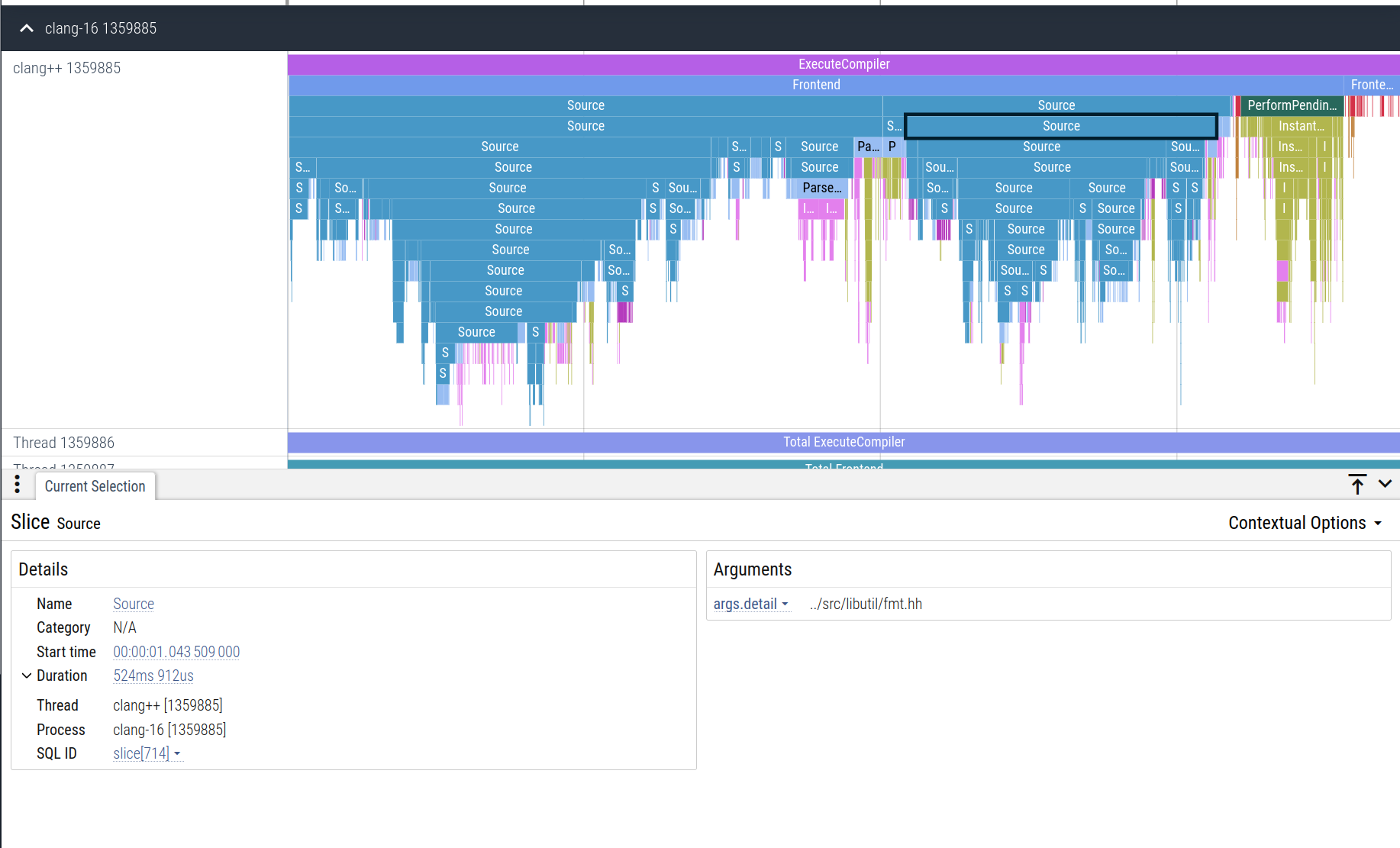
The most general spans of compile time are at the top, and the constituent spans are shown as you go down.
Successful build time reduction CLs
See the build-time-optimisation Gerrit topic for more related things.
Commit porting (cherry-picking) guide
This guide is primarily about CppNix->Lix commit ports and was written when we were doing a lot of those before 2.90. It also applies to Lix->Lix ports, though, those are much easier, often just taking clicking "cherry pick" in the gerrit UI.
Don't forget, using Gerrit is a bit different than other systems.
Lix -> Lix ports
We generally only backport fixes from main if there are severe bugs that users will hit in production, or if we had to patch the derivation in nixpkgs. The only real thing to remember about this is to use git cherry-pick -x. Gerrit will match up the Change-Ids and link the CLs on release branches to the other CLs on release branches or main. Then, push as if any other change: git push origin HEAD:refs/for/release-2.92 (e.g.).
You can also use the cherry-pick button in the Gerrit UI.
CppNix -> Lix ports
Commit style:
- Remember to use
git cherry-pick -xto generate the(cherry-picked from abc)line. - It's strongly preferred to include a link to the PR as
Upstream-PR: https://github.com/nixos/nix/pulls/123in the trailer of the commit message.
GitHub encourages messy branch history, so the cherry-picking procedure can be rather annoying in a codebase like Lix which mandates that every commit passes CI. However, this document describes how we have generally done it.
Also note that we have renamed src/ to lix/, which may or may not confuse git sometimes.
Procedure (focused mostly on CppNix -> Lix)
single commits
try git cherry-pick -x first. if this works, excellent. if not, apply the usual cherry-picking procedures:
- track down apply failures to intermediate changes. maybe cherry-pick those first if they're not too awful, but experience shows that they usually are too awful
- anything that touches the store or contains the word
Accessorin the vicinity probably needs to be picked about and rewritten from scratch. that stuff is evidence of the CppNix version of lazy trees which is not in Lix. - always test ofc, even if something applies cleanly it will sometimes just fail to build (or worse, run)
- nix prs tend to have broken inner commits. it is often necessary to pick parts from later commits in a pr to fix ci, in that case note this down as
fixes taken from <commits...> - sometimes a commit may be so broken that it can't reasonably be fixed except by squasing it with some other commit, in that case just squash them and not it down somehow (either with multiple
cherry picked fromcommit hashes or multiple commit message+cherry-pick-hash blocks, depending on whether the fix messages were any useful)
full prs
single-commit prs were mostly picked using cherry-pick -x -m1 to keep the association with the upstream pr number for clarity. this implicitly squashes the pr into a single commit so it's only useful for single-commit prs. (some prs that have broken intermediate commits also benefit from this, but see above for that)
when pushing these to gerrit please set a topic like backport-<pr-number> using push options (-o topic=backport-<pr-number> in git push) to delineate one picked pr from a pr that depends on it
Misc tips
pyright is not dealing with import paths correctly for functional2
I don't know why it's doing this but it seems to be assuming that the functional2 test suite is relative to the workspace root.
You can jam the following into :CocLocalConfig for vim, and probably the workspace config for VSCode and it should fix it.
{
    "python.analysis.include": ["tests"],
    "python.analysis.extraPaths": ["tests"],
}
buildbot user style to make the pulsing pills bearable
@keyframes pulse_animation {
  0% { transform:scale(.9) }
  50% { transform:scale(1) }
  to { transform:scale(.9) }
}

.pulse {
    animation-duration: 10s !important;
}
FIXME: someone should PR this, now that we have the ability to patch buildbot
run all lix vm tests locally
tests=$(
    nix eval --json --impure \
        --apply '
            let f = n: t:
                if __isAttrs t
                then (if t.type or "" == "derivation"
                    then (if t.system == __currentSystem
                            then [ n ]
                            else [])
                    else __concatMap (m: f "${n}.${m}" t.${m}) (__attrNames t))
                else [];
            in f ".#hydraJobs.tests"
        ' \
        .#hydraJobs.tests \
        | jq -r '.[]'
)

nix build --no-link -L ${tests[@]}
check out current patchset of a cl by git alias
put this in a gitconfig that can configure aliases:
[alias]
	cocl = !\
	 ps=$(\
	   ssh $(git config remote.origin.gerriturl) \
	     gerrit query --format=json --current-patch-set $1 \
        | jq -sr .[0].currentPatchSet.ref \
	 ) && git fetch origin $ps && git checkout FETCH_HEAD && true
then run as git cocl <cl-number>. needs a git config remote.origin.gerriturl gerrit.lix.systems, or some other url that ssh can connect to. (could've extracted it from the remote url but we didn't want to do that much shell)
git stuff
git-revise
git-revise is a cool tool for splitting and shuffling commits in-memory without breaking your working tree. it's great.
It also has some broken stuff with respect to gerrit commit-msg hooks. However, this can be fixed (this is opt-in because some commit-msg hooks make unsound assumptions but the gerrit one should be fine):
# allow gerrit git hooks to run on git-revise
[revise "run-hooks"]
        commit-msg = true
Making git clean clean the stuff that isn't removed by make clean
If you don't want to use git clean -x to remove all git-ignored stuff, but want to remove things that are generated in Lix's build process but aren't removed by make clean, apply this patch: no-ignore-not-cleaned.patch
Building Locally
See hacking.md in the Lix repo for the main documentation. Extra tips can go here.
RISC-V support
Goal: install lix on a riscv64-linux system
The target is a DevTerm R-01, so it's an AllWinner D1 RISC-V processor @ 1GHz, with 1GB of memory and 32GB of microSD.
We can't run the Lix installer without building it, because there's no canned build for it. So let's try building it natively:
$ rustup
$ git clone https://git.lix.systems/lix-project/lix-installer
$ cd lix-installer
$ RUSTFLAGS="--cfg tokio_unstable" cargo install --path .
This doesn't work because there's some conditional complication^Wcompilation that
doesn't cover riscv64. So we need to open self_test.rs and add an entry:
    #[cfg(all(target_os = "linux", target_arch = "riscv64"))]
    const SYSTEM: &str = "riscv64-linux";
At this point, it will, in principle, build. In practice, however, 1GB is just not enough RAM. If you add some swap it'll make it to the last step, but then it wants 1.5GB+ for that. I wouldn't try it on a system with less than 2GB, and ideally more.
Ok, native build is a bust unless I want to let it thrash all night. So let's
cross-compile it on ancilla, which is, conveniently, already running nixos.
The nix-installer flake doesn't come with riscv64 cross support, and rather than try to figure it out I just winged it with nix-shell. I am skipping over a lot of false starts and blind alleys here as I ran into things like dependency crates needing a cross-compiling gcc, or rust not having a stdlib on riscv64-musl.
$ git clone https://git.lix.systems/lix-project/lix-installer
$ cd lix-installer
$ $EDITOR shell.nix
with import <nixpkgs> {
  crossSystem.config = "riscv64-unknown-linux-gnu";
};
mkShell {
  nativeBuildInputs = with import <unstable> {}; [ cargo rustup ];
}

$ nix-shell
[long wait for gcc to compile]

$ export RUSTUP_HOME=$PWD/.rustup-home
$ export CARGO_HOME=$PWD/.cargo-home
$ rustup default stable
$ rustup target add riscv64gc-unknown-linux-gnu
$ edit src/self_test.rs
[apply that same patch to SYSTEM]
The build invocation is a bit more complicated here, because we need to tell it where to find the linker:
$ RUSTFLAGS="--cfg tokio_unstable" cargo build \
    --target riscv64gc-unknown-linux-gnu \
    --config target.riscv64gc-unknown-linux-gnu.linker='"riscv64-unknown-linux-gnu-gcc"'
[another long wait]

$ file target/riscv64gc-unknown-linux-gnu/debug/lix-installer
target/riscv64gc-unknown-linux-gnu/debug/lix-installer:
  ELF 64-bit LSB pie executable, UCB RISC-V, RVC, double-float ABI,
  version 1 (SYSV), dynamically linked,
  interpreter /nix/store/g4xam7gr35sziib1zc033xvn1vy9gg8m-glibc-riscv64-unknown-linux-gnu-2.38-44/lib/ld-linux-riscv64-lp64d.so.1,
  for GNU/Linux 4.15.0, with debug_info, not stripped
Since we couldn't do a static musl build it needs the nix ld.so, but we can get around that!
$ scp target/riscv64gc-unknown-linux-gnu/debug/lix-installer root@riscv:.
$ ssh root@riscv
# ./lix-installer
-bash: ./lix-installer: no such file or directory

# ldd ./lix-installer
/nix/store/.../ld-linux-riscv64-lp64d.so.1 => /lib/ld-linux-riscv64-lp64d.so.1
[other output elided]

# /lib/ld-linux-riscv64-lp64d.so.1 ./lix-installer
The Determinate Nix installer (lix variant)
[...]
Sadly we can't actually use it to install, because nix_package_url needs a default value,
and on RISC-V, it doesn't have one! It's self_test.rs all over again except it
doesn't manifest until runtime.
So, off to src/settings.rs we go. It doesn't need to be a valid URL, just something URL-shaped.
/// Default [`nix_package_url`](CommonSettings::nix_package_url) for unknown platforms
pub const NIX_UNKNOWN_PLATFORM_URL: &str =
    "https://releases.lix.systems/unknown-platform";
    #[cfg_attr(
        all(target_os = "linux", target_arch = "riscv64", feature = "cli"),
        clap(
            default_value = NIX_UNKNOWN_PLATFORM_URL,
        )
    )]
Rebuild, re-push, re-run:
# /lib/ld-linux-riscv64-lp64d.so.1 /opt/lix-installer install linux
Error:
   0: Planner error
   1: `nix-installer` does not support the `riscv64gc-unknown-linux-gnu` architecture right now
Ok, missed a few places in settings.rs, let's put a quick and dirty hack in there:
            #[cfg(target_os = "linux")]
            (_, OperatingSystem::Linux) => {
                url = NIX_UNKNOWN_PLATFORM_URL;
                nix_build_user_prefix = "nixbld";
                nix_build_user_id_base = 30000;
                nix_build_user_count = 32;
            },
            #[cfg(target_os = "linux")]
            (_, OperatingSystem::Linux) => {
                (InitSystem::Systemd, linux_detect_systemd_started().await)
            },
It also needs a tarball to install; jade_ kindly updated the flake for it to support riscv64,
so we just check it out (or, well, check out review branch 1444) and then
nix build -L .#nix-riscv64-linux.binaryTarball and away we go.
This, it turns out, also doesn't work, because the installer is hardcoded to expect the directory the tarball contains to start with nix-*. You can either unpack and repack the tarball to meet that requirement, or find all the places in lix-installer that assume that and edit them -- they're in src/action/base/move_unpacked_nix.rs and src/action/base/setup_default_profile.rs.
Finally, this particular kernel lacks seccomp support -- in order to get it working, I had to edit the lix (not lix-installer) package.nix and add (lib.mesonEnable "seccomp-sandboxing" false) to the meson flags.
And with that done, it works!
root@devterm-R01:~# uname -a && nix --version
Linux devterm-R01 5.4.61 #12 PREEMPT Wed Mar 30 14:44:22 CST 2022 riscv64 riscv64 riscv64 GNU/Linux
nix (Lix, like Nix) 2.90.0pre20240613_dirty
Branches
The Lix repository contains multiple releases in parallel. The branches work as follows:
-
main. This contains major tags (except for 2.90 because of an early branch-off. We might fix that manually?), and is for the next major version of the software. This is where new development typically happens. -
release-*. These contain tags for*.0and further minor releases on a major release. We generally try to not backport things, since we would much rather get another major release out. (subject to revision; we would really like to not have LTS releases, but distro may make us do it?). These branches are development branches for a given release after it is released. - (suggestion?)
stable-*- Branch which is always pointed at the latest tag in that given major version.
Version types
- Full release, e.g. 2.90.0. This is a snapshot of HEAD that we believe is stable for release and that we have fully performed out-of-tree validation on.
- Beta release, e.g. 2.90.0-beta.1. This is something that we would consider running in more or less any environment, given that we all run HEAD ourselves. This is an arbitrarily selected snapshot of HEAD that we are deciding to produce installers for, and is not special.
- Release candidate, e.g. 2.90.0-rc1. This is something that we would just release but it needs a bit more out-of-tree validation.
Git tags
Docker tags
-
latest- The latest minor version of the latest major version -
2.90and similar - The latest minor version of the2.90major release. -
2.90.0- Exactly2.90.0.
Working Groups
What are they?
Lix doesn't have a very formal development structure - ice cream isn't a stranger to being fluid, after all! But all of the contributors have a different shape - so they are naturally drawn to different parts of the project. Documenting that is useful - for making communication more streamlined, and for a high-level overview on what activities are there!
People working on some part of the project are called "working group". But that's not all! There might be other people that are looking to help that area - they would be interested to join! Some cool projects depend on others, and so people who monitor the prerequisite project would be tracking it. And of course, some projects can be understaffed, in other words: help wanted.
C++ Code
IPC Rewrite
horrors is doing it, @raitobezarius and @jade_ on review
Evaluator Changes
@piegames
Rust Code
Lix Installer
@KFears
Help wanted!
NixLang parser rewrite
@piegames wants to do it, waiting for Rustification of the codebase
Lix Logging
@jade_ wants to do it, blocked on Rustification
@KFears is interested to join
Documentation
See this: https://wiki.lix.systems/books/lix-contributors/page/docs-rewrite-plans
There also exist issues in Lix bug tracker: https://git.lix.systems/lix-project/lix/issues?labels=151
Integration Work
Lix Rustification
@jade_ drives it
@KFears and @piegames are tracking the progress
Infra
@raitobezarius
@KFears is interested to join (a bit :P)
Release Engineering
@jade_ knows a lot, but the project hasn't seen much activity lately due to burnout
@KFears is interested to join
Testing
Lix integration tests are a bit of a mess: some are in pytest, some are in Bash scripts
https://git.lix.systems/lix-project/lix/issues?labels=121
tests/functional2
@Commentator2.0 and @helle mainly, with @piegames, @pennae and others handling reviews and helping out
External Issues
There are a bunch of different ones! Some are integration work, some are Go, some are Java, some are Python, some are NixLang. Take a look!
https://git.lix.systems/lix-project/external-bugs
Dealing with CI
Logging in to CI for restarts
Go via https://buildkite.com/sso/lix-project and use your Lix account.
Style Guide
Not just about code, a style guide is a list of decisions we've made, that we want to be consistent about going forwards. It does not need to be comprehensive of all possible issues, nor does it need to confine itself to trivial topics such as formatting. It's a tool for ourselves so we don't forget where we've been, and can avoid solving the same problems again.
Don't be shy about adding to it. Things written here do impose some burden, but the hope is that they lessen other burdens in the long run. Use your judgement about what's worth it.
Please fix style issues in existing code as you encounter them. Style is aspirational, a journey not a destination. :)
Language and terminology
Language
Most existing Lix documentation is written in British English. We intend to continue with that.
Terminology
(FIXME: unsure if this should be in the style guide but ... it kinda should be -jade)
-
Nix language - Use this to refer to the language which haunts us all.
-
Nix - Nix refers to the technology. Used when referring to the Nix store, for example. Or, to a Nix derivation. Lix is a Nix implementation.
-
CppNix - This is the preferred term for when it is necessary to refer to Nix, the software that Lix is forked from, rather than the technology.
-
Lix - Use Lix when referring to the implementation. For example, "Install Lix".
-
nix,nix-build, etc - Use lowercasenixwhen referring to thenixcommand, which is still supported by Lix.
Code
Code changes
Tests
If at all practicable, all new code should be tested to some extent. If writing a test is hard, we need to prioritize making it easier, and potentially block features if that is the case.
Documentation
Reference documentation should be added, in addition to release notes (doc/manual/rl-next-dev), for user visible changes.
For notable dev facing changes, consider adding release notes in doc/manual/rl-next-dev. This is not critical for all changes; in some cases it may make more sense to write it up in dev documentation instead, and indeed it may be ok to defer writing that dev documentation (it's helpful to create an issue to not forget).
Benchmarking
Changes that touch the core of the evaluator or other performance critical code in Lix should be benchmarked.
See bench/README.md for instructions.
Changelist size
If a CL is too long to review, it should be split up into smaller pieces with tests. The exact length varies but passing the 1000 line mark should give significant thought to splitting.
- When a CL is split, each commit should still be a valid state (tests passing, etc). If you must, you can gate in-progress changes with a flag or similar until the final commit. (Qyriad)
Commit messages
Include at least a sentence or two as to why you are making a commit. For example, it can be nice to have the reproduction of a bug in the commit message. The commit message is the message for your review.
There's no particular format or specific style for commit messages; just make sure they're descriptive and informative.
C++
While we hope to migrate the Lix interpreter from C++ to Rust eventually, C++ is a language that is likely to exist for a long time, and we may end up having to use it in other contexts.
Lix is a C++20 codebase. Features of C++20 that compile on all supported platforms can be used.
NULL vs nullptr
nullptr where at all possible.
Static vs anonymous namespace
Prefer anonymous namespace, both currently exist in the codebase (jade: any other opinions?).
Type Aliases with typedef vs using
Prefer using declarations, as they can be used in more places, can be templatized, and have clearer syntax. Both currently exist in the codebase. (Qyriad)
TODO/FIXME/XXX Comments
jade: this is not consistent with the conventions I use, needs further discussion imo (TODO: block in pre-commit hook, used in local tree but should never pass code review, FIXME(name||feature): its busted, someone should go fix it later, XXX: this is bad, we are writing down that it is ugly but leaving it as-is as we didn't figure out a better way)
Something along the lines of:
- TODO: acknowledgement that something is acceptably-for-now incomplete, especially if the scope of fixing it is high or unknown
- FIXME: this should be fixed before the feature or major change that it's a part of is considered "ready"
- XXX: this should not pass code review and should be considered a left-in mistake
Header files
Filenames
Headers should end with .hh. This reduces the likelihood anyone will try to include them from C files, which would require following the rules of both languages and is easy to get wrong.
The implementation of the functions declared in a .hh file should be in a .cc file of the same name, absent reasons to do otherwise.
Order-independence
Headers should not care what order they're loaded in.
The exception, for now, is config.h in the lix repo. This must always come before all other headers. This observation should not be taken to imply it must always be that way, but at the moment it's helpful to be aware of.
Idempotence
Use #pragma once, it helps. You can see this in most existing header files.
///@file and header documentation
///@file should be at the top of all nix headers - Doxygen and other tools use it to decide whether a header should have documentation generated for definitions in it. See the relevant Doxygen documentation for more details.
Strongly consider adding a description of the purpose of a header file at the top of it in with @brief A sentence saying what it is for.
Examples:
/**
 * @file
 * @brief This header is for meow meow cat noises.
 */
/// @file
/// @brief meow meow meow
Source files
Filenames
Source files should end with .cc.
Python
Python is a widely used tooling language in the Lix codebase.
It's used in the test suite in functional2, a pytest based test suite intending to replace the Bash functional test suite.
It's what the release engineering in releng/ is written in.
In general, follow PEP-8 while writing Python code: identifier style should be the typical Python one per PEP-8, indents are 4 spaces, etc.
In the near future, we will autoformat Python code with ruff.
Type annotations
Type annotations should be used where they are helpful, and should be used for parameter and return types of functions. If it is too much of a bother to convince the type checker of something, it is acceptable to put an Any there.
Prefer inserting Any if the alternative is lying to the type checker via # type: ignore comments.
dataclasses is a useful library that produces nicer, more typed, code, and it is widely used.
It's the correct choice for most classes which are just blobs of data.
Doc strings
Please write them. Single-line ones are better than none at all.
We use the Sphinx docstring format for parameter documentation, though we currently do not generate Sphinx docs for our Python codebases. See this Sphinx tutorial for an example and the Sphinx domains reference for reference.
Nix language
Unsurprisingly Nix contains Nix code. Some amount is tests and a lot is packaging.
We use the nixfmt formatter on files outside the test suite. It's run through treefmt with pre-commit hooks. Nix code outside the test suite is expected to be formatted.
Test suite files need not be formatted with the formatter at this time, but please consider doing so with new tests that don't rely on formatting.
with
Prefer not to use with to bring things into scope as it obscures the source of variables and degrades language server diagnostics.
Use let inherit (attrset) attrs instead.
Meson
Generally based on the style in Meson's docs made consistent and with a couple tweaks; notably multiline function calls are done in "block style" (think like rustfmt does it), rather than aligned, e.g.:
executable('sdlprog', 'sdlprog.c',
  win_subsystem : 'windows',
  dependencies : sdl2_dep,
)
rather than:
executable('sdlprog', 'sdlprog.c',
           win_subsystem : 'windows',
           dependencies : sdl2_dep)
Meson's docs go back and forth on this, but we also put a space before and after the colon for keyword arguments (so win_subsystem : 'windows', rather than win_subsystem: 'windows').
Operations
Operational Conventions
Code Review
Self Stamping and Merging
On our Gerrit, core members have permissions to +2 any arbitrary CL, because sometimes we should be able to get something in quickly, and talk about it afterwards. In almost every case, the author of a change should not +2 their own CL, however Lix members may use their best judgement so long as they talk about it with the team when they can. Some cases where skipping synchronous review is a good idea:
- Reverting commits that accidentally broke main
- Fixing typos in other peoples' CLs that you would have +2'd, then +2'ing the edited CL
- Maybe typo fixes in
main, though those can probably wait to be reviewed
Just make sure to talk about what you do :)
Contributor permissions and Code Owners
One might wonder how permissions work on Lix and how one can help out with certain tasks. This is subject to ongoing governance work. This page is a summary of the current (pretty vibes-based) state of how it works.
Feel free to ask questions about this in the Lix development Matrix room.
Trusted contributors
We give away this permission freely to everyone who has commits in Lix and most people who ask for it with a reason to need it. It confers the rights to:
- Triage issues on Lix project repos
- Edit the wiki
- Access login-only pads on https://pad.lix.systems
Lix approvers
This is the Code-Review+2 permission on Gerrit.
We're working on setting up Code Owners on Gerrit so that changes to specific subsystems require review from a subsystem author or an override. We will likely give away approver access to most active contributors at that point. This permission is given out to responsible contributors to Lix who have been working on Lix for a bit and have shown good understanding of expectations in the project.
There will probably be a more specific process in the future. Currently it's by nomination by people on the Lix team.
Lix team
This category is very much subject to governance work to clarify how it should work. People in this group share administrative infrastructure access with infra maintainers and the Lix community team.
You can ask for help with any infrastructure issues from the Lix team.
Gerrit Code Owners
Gerrit has a concept of "Code Owners". The idea of this is that people responsible for subsystems are required to approve changes to code in their subsystem.
This is hierarchical in terms of specificity, that is to say, the emails of users in the nearest OWNERS file will be suggested first for review requests when clicking "Suggest Owners", before going up to more general reviewers and if all else fails, the global approvers.
If you work on an area in Lix and want to review changes to your area, feel free to add yourself to the OWNERS file for the relevant directory (or the rules for individual files in there).
As of July 2025, we are still working on crystallizing how the code owners plugin should interact with our workflow.