
Codebase overview
The Lix system is constituted of two broad parts, the evaluator and the store daemon. The two pieces may run on the same machine or on different machines.
For example, in a remote build setup like https://hydra.nixos.org, one node is running several evaluators in parallel, and builds are dispatched to several builder nodes.
(fyi to anyone editing this, double click the image in the preview to edit it)
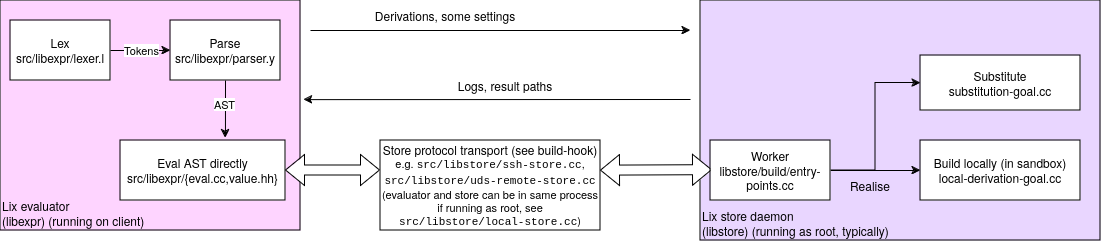
Evaluator
The evaluator is an AST tree-walking evaluator with lazy semantics.
Notable files:
Known design flaws
- GC issues (FIXME add details)
- General tendencies to leak memory. Hydra restarts the evaluator every so often if it runs out of memory.
Lix team plans
- Rewrite parser (done, being ported for 2.
91)91 by horrors) - Rewrite evaluator to be amenable to moving to bytecode (horrors) (long term)
Store protocol
The store protocol is a hand rolled binary protocol with monotonically increasing versioning. It runs over a few different transports such as ssh (src/libstore/ssh-store.cc) or Unix sockets (src/libstore/uds-remote-store.cc).
Known design flaws
- We cannot extend the store protocol (not that it is Good) because of the monotonic version numbers: we must always be stuck at some released C++Nix
versionversion. This significantly moves up the need to replace it. - The code is significantly tangled with the current protocol design.
Lix team plans
- Replace protocol with capnproto, transport with websockets?
- Would likely be in addition to existing protocol; existing protocol likely would be run through a translator.
Store daemon
The store daemon takes derivations (≈ execve args and dependencies) and realises (builds or substitutes) them. It also implements store path garbage collection.
Lix's local store implementation currently uses a SQLite database as the source of truth for mapping derivation outputs to derivations as well as maintaining derivation metadata.
Notable files:
Known design flaws
- Sandbox is of dubious security especially on Linux (where it is actually expected to be somewhat secure)
- Overall tangled code around the sandbox, particularly in platform specific parts